





What's Happening?
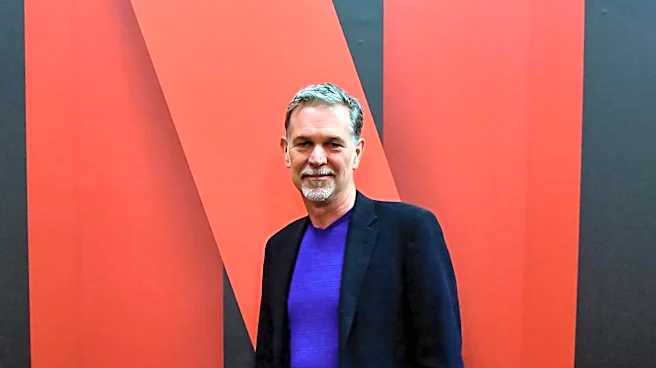
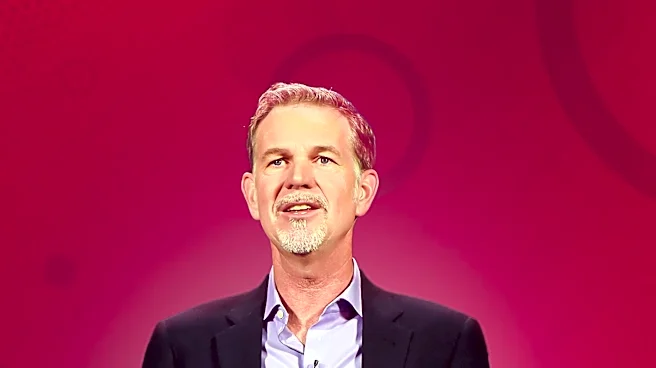
Reed Hastings, co-founder and chairman of Netflix, has championed a distinctive management philosophy centered on 'freedom, responsibility, and high performance.' This approach, detailed in his book 'No Rules Rules,' co-authored with Erin Meyer, emphasizes
empowering employees rather than imposing strict controls. Hastings believes that competent and responsible managers should avoid excessive supervision and procedures, allowing employees to proactively determine how to achieve common goals. This philosophy, termed 'context, not control,' suggests that leaders should provide comprehensive information about business situations, objectives, and challenges, enabling employees to make informed decisions independently. Netflix also commits to paying competitive salaries to attract and retain top talent, operating on the principle that a small team of exceptional individuals is more effective than a large organization with varied skill levels. The company prioritizes performance, contribution, and suitability for a role over seniority or loyalty, even employing a 'Keeper Test' to evaluate whether an employee would be retained if they announced their resignation.
Why It's Important?
This management philosophy has significant implications for corporate culture and talent management within the U.S. business landscape. By advocating for 'context, not control,' Hastings challenges traditional hierarchical structures and promotes a model where employee autonomy and accountability are paramount. This approach can foster greater creativity, proactivity, and innovation within organizations, potentially leading to more agile and responsive businesses. For employees, it offers increased empowerment and trust, which can boost job satisfaction and engagement. For companies, adopting such a model could lead to more efficient operations and a stronger competitive edge by attracting and retaining high-caliber talent. However, it also demands a robust hiring process to ensure a high 'talent density' and a culture where individuals are truly capable of self-direction and responsible decision-making. The emphasis on performance over tenure could also reshape how employee loyalty and career progression are viewed in modern corporations.
What's Next?
The continued success of Netflix, partly attributed to this management style, may encourage other U.S. companies to re-evaluate their own corporate cultures and management practices. Businesses struggling with employee engagement, innovation, or talent retention might look to Netflix's model as a blueprint for reform. This could lead to a broader shift in corporate America towards more decentralized decision-making, increased employee autonomy, and a greater focus on performance-based evaluations. Management consultants and business schools may further analyze and disseminate these principles, potentially integrating them into leadership training programs. As the workforce evolves, particularly with younger generations seeking more purpose-driven and autonomous work environments, the 'context, not control' philosophy could become a more prevalent and sought-after organizational structure, influencing hiring strategies and workplace policies across various industries.
Beyond the Headlines
The 'context, not control' philosophy extends beyond mere management tactics; it touches upon fundamental aspects of trust, human potential, and organizational design. Ethically, it places a high degree of trust in individual employees, fostering an environment where personal responsibility is paramount. Legally, while promoting freedom, it implicitly requires clear communication of company goals and ethical boundaries to prevent misuse of autonomy. Culturally, it challenges the ingrained notion that strict oversight is necessary for productivity, suggesting that a culture of high performance can thrive on empowerment. This approach could trigger long-term shifts in how companies view their employees—not just as cogs in a machine, but as intelligent, self-directed contributors. It also highlights the importance of a strong organizational culture that can guide individual decisions without explicit rules, potentially leading to more resilient and adaptable businesses in an ever-changing global market.