








What's Happening?
Jacob Kramer's book, 'Wandermelon,' tells the story of a watermelon seed that grows wild and wanders through a town. The narrative follows the vine's journey through various locations, including fields, a compost pile, a classroom, and around a water slide,
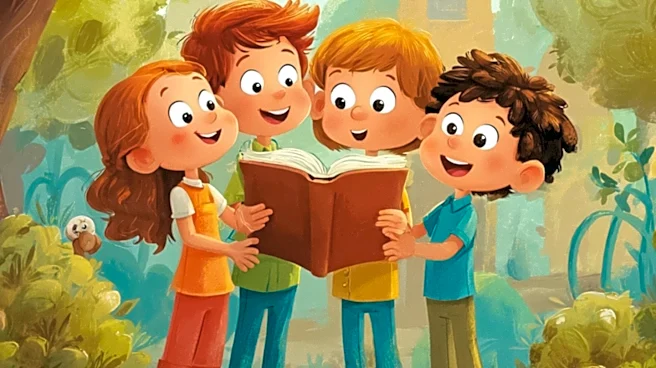
captivating the town's residents. The children in the story become particularly engaged, even creating a song about the watermelon's growth and their desire to taste it. The book, illustrated by Yara Bamieh with colorful watercolors, depicts both the above-ground growth of the vine and its underground rooting, while also showcasing the interactions of the lively townspeople with the plant. The story culminates in a dispute over who has claim to the melon when a waterslide operator attempts to charge for a bite, leading to arguments about ownership.
Why It's Important?
This children's book serves as a significant tool for initiating discussions among young readers about fundamental concepts such as growth, possession, and the equitable sharing of natural resources. By presenting a whimsical scenario where a single watermelon vine becomes a community focal point, the story encourages children to consider the implications of collective ownership versus individual claim. The conflict that arises when an attempt is made to commercialize access to the melon highlights real-world issues concerning resource allocation and fairness. This narrative can foster early critical thinking skills regarding economic principles and social justice, prompting children to reflect on how communities manage shared assets and resolve disputes over valuable resources. The book's playful approach makes these complex themes accessible and engaging for a young audience.
What's Next?
The book's conclusion, described as 'highly satisfying,' suggests a resolution to the ownership dispute, implying that the 'magical-seeming fruit' ultimately dictates its own fate. This outcome is likely to lead to further discussions among young readers and their educators or parents about the nature of shared resources and the importance of community harmony over individual gain. The story's open-ended exploration of these themes means that its impact will continue through the conversations it sparks. Educators might use 'Wandermelon' as a springboard for classroom activities focused on environmental stewardship, cooperative behavior, and understanding different perspectives on ownership. The book's ability to prompt thoughtful dialogue ensures its relevance as a teaching aid for social and ethical development.
Beyond the Headlines
Beyond its immediate narrative, 'Wandermelon' delves into deeper ethical and cultural dimensions by subtly questioning the commodification of natural growth and the inherent value of shared experiences. The dispute over charging for a bite of the watermelon can be seen as a microcosm of broader societal debates regarding access to essential resources and the commercialization of public goods. The book's emphasis on the watermelon's 'mind of its own' introduces a subtle element of nature's autonomy, suggesting that some things are beyond human control and ownership. This perspective can encourage a more respectful and less exploitative view of the natural world, fostering an appreciation for ecological processes and the benefits they provide to communities without necessarily being subject to human-imposed economic structures. It promotes a cultural shift towards valuing communal enjoyment and natural abundance.