








What's Happening?
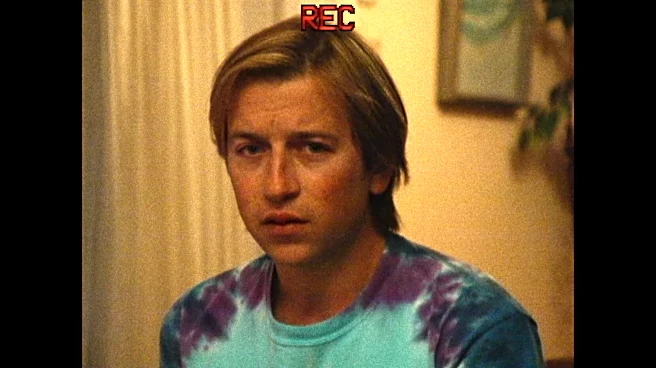
Actor Robert Pattinson has discussed his ongoing amusement and confusion regarding the viral 'tracksuit Robert Pattinson' meme. The image, originally posted by 'Good Time' director Josh Safdie in 2017, depicts Pattinson in an Adidas track jacket and camo
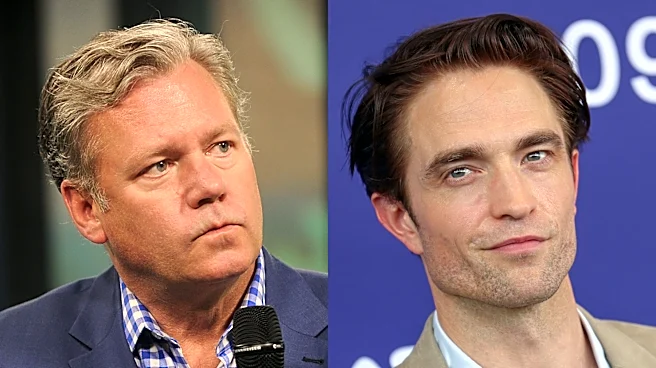
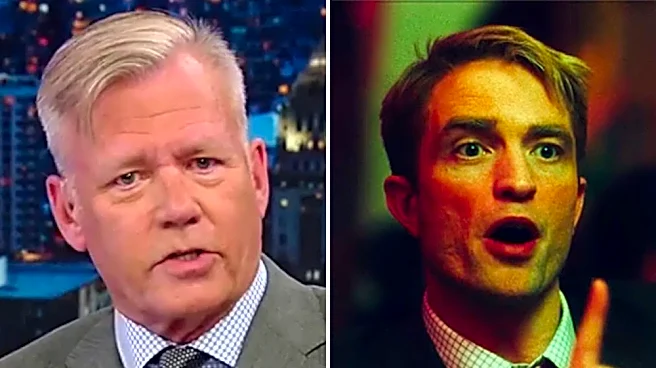
pants, standing awkwardly in a kitchen. Despite its widespread popularity, Pattinson admits he still doesn't understand why it became a meme, likening his bewilderment to feeling like a 'boomer.' The meme gained significant traction after a Twitter user shared it with a humorous caption, leading to over 101,000 likes. Pattinson previously referenced the image during a Vogue 'Off the Cuff' video with Zendaya when asked about viral memes or conspiracies related to himself. His current role in the film 'Primetime,' where he plays 'To Catch a Predator' host Chris Hansen, further connects him to meme culture, as Hansen himself was a subject of memes. Director Lance Oppenheim noted that Pattinson discovered Hansen through a meme shortly after moving to America.
Why It's Important?
This phenomenon highlights the pervasive influence of internet meme culture on public figures and popular perception. For actors like Robert Pattinson, viral images can transcend their original context, becoming enduring elements of their public persona, often beyond their control or comprehension. This situation underscores how digital content, even seemingly innocuous photos, can be reinterpreted and disseminated, shaping public discourse and celebrity branding in unexpected ways. The meme's longevity, despite Pattinson's lack of understanding, illustrates the decentralized and often illogical nature of internet humor and its power to create shared cultural touchstones. Furthermore, the connection to his role in 'Primetime' suggests a meta-commentary on meme culture itself, where the actor, already a meme subject, now portrays another figure known for being memed. This intertwining of celebrity, media, and internet trends reflects a broader shift in how public figures are perceived and how narratives are constructed in the digital age.
What's Next?
The 'tracksuit Robert Pattinson' meme is likely to continue its circulation, periodically resurfacing in online discussions and social media. Pattinson's recent comments may even reignite interest in the meme, potentially leading to new interpretations or a fresh wave of shares. For the film 'Primetime,' the existing meme culture surrounding Pattinson and his character, Chris Hansen, could serve as an organic promotional tool, drawing in audiences familiar with these internet phenomena. Director Lance Oppenheim's embrace of the 'mimetic sort of existence' suggests that future promotional efforts for 'Primetime' might lean into this aspect, leveraging the inherent meme-ability of the film's subject matter and its star. This approach could set a precedent for how filmmakers and publicists engage with internet culture to promote their work, recognizing the power of viral content to generate buzz and connect with audiences.
Beyond the Headlines
The 'tracksuit Robert Pattinson' meme, and Pattinson's reaction to it, offers a fascinating glimpse into the evolving relationship between celebrities and their digital footprint. It raises questions about authorship and control in the age of user-generated content, where an image posted by a director can be recontextualized and gain a life of its own. The actor's candid admission of not 'getting' the meme highlights a generational and cultural divide in understanding internet humor, where meaning is often fluid and collectively constructed rather than explicitly stated. This phenomenon also touches upon the broader implications of digital immortality, where moments, once fleeting, are preserved and endlessly re-shared, contributing to a celebrity's enduring legacy in ways that traditional media could not. It underscores how internet culture can democratize fame, allowing ordinary users to shape narratives around public figures, sometimes to the bewilderment of the figures themselves.