







What's Happening?
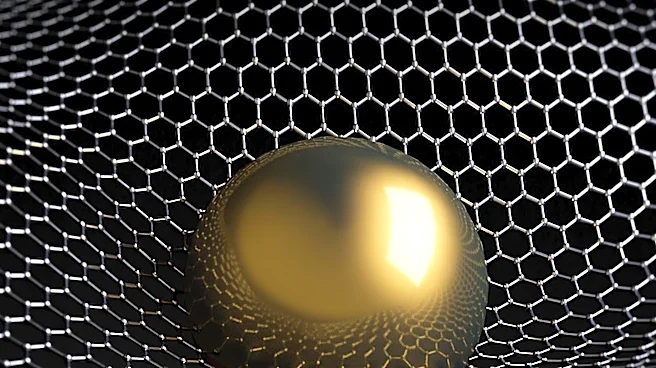
A research team led by Aalto University has successfully used machine learning to identify and confirm two new kagome superconductors, YRu3B2 and LuRu3B2. The study, published in Physical Review Research, highlights the use of machine-learning-guided
screening to narrow down a large chemical search space, followed by first-principles calculations and experimental validation. The superconductors exhibit critical temperatures of 0.81 K and 0.95 K, demonstrating the potential of AI to streamline the discovery process. This approach emphasizes the importance of physics-informed features and high-precision candidate ranking in producing lab-verifiable discoveries.
Why It's Important?
The application of AI in superconductor discovery represents a significant advancement in materials science, potentially accelerating the development of new materials with unique properties. By reducing the time and resources required to identify viable candidates, AI-driven methods can enhance the efficiency of research and development in this field. The successful identification of new superconductors could lead to breakthroughs in various applications, including energy transmission, magnetic resonance imaging, and quantum computing. This development underscores the transformative impact of AI on scientific research, offering a model for future studies in other complex domains.
What's Next?
The research team plans to continue refining their AI-driven approach to further expand the discovery of superconductors. Future efforts may focus on increasing the critical temperatures of identified materials, moving closer to room-temperature superconductivity. Collaboration with other institutions and industries could facilitate the practical application of these discoveries, potentially leading to new technologies and innovations. As AI continues to evolve, its integration into scientific research is likely to become more prevalent, driving advancements across multiple disciplines.