



What's Happening?
Shawn Fain, President of the United Auto Workers (UAW), has issued a warning regarding the potential threat of artificial intelligence (AI) and automation to workers' rights. This statement comes as General Motors (GM) plans to significantly increase
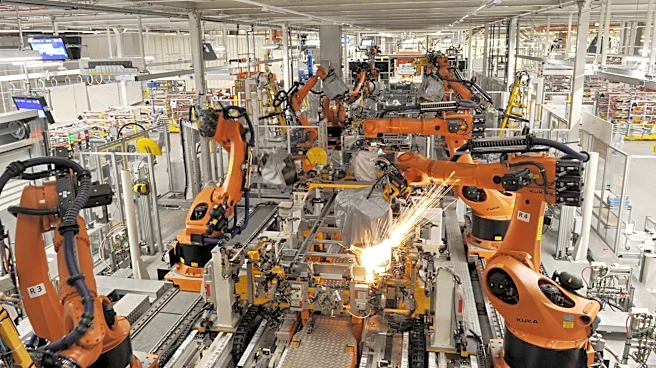
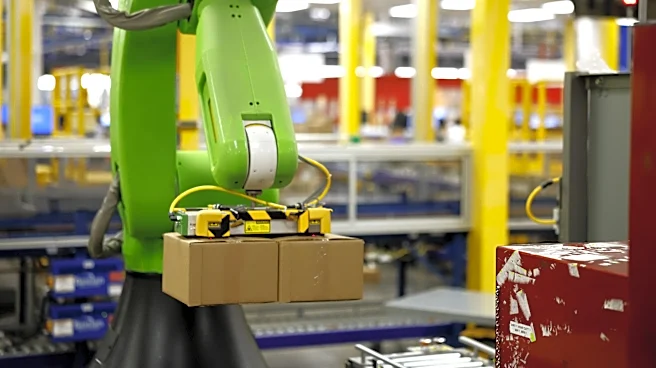
its use of robots and automation technology in its North American production facilities by 20% by 2028. GM's strategy aims to offset rising production costs, particularly increased labor expenses following the 2023 UAW collective bargaining agreement, which led to substantial wage increases for autoworkers. The company is developing its own robots, focusing on autonomous mobile robots (AMRs) for internal logistics, shifting from purchasing equipment to in-house development and production. This move is part of a broader automation strategy across GM's supply chain, requiring parts suppliers to submit automation plans and incorporating automation levels into contract evaluations. While GM asserts that automation enhances safety, quality, and efficiency, the UAW views it as a means to reduce the workforce.
Why It's Important?
The expansion of automation by major U.S. automakers like GM carries significant implications for the American labor force and the future of manufacturing. The UAW's concerns, voiced by President Fain, highlight a growing tension between corporate efforts to boost efficiency and profitability through technology, and the potential displacement of human workers. The increased use of AI and robotics could lead to job losses in the automotive sector, impacting the economic stability of communities reliant on these manufacturing jobs. This shift also raises questions about the nature of future work, the need for retraining programs, and the role of unions in protecting workers' interests in an increasingly automated industrial landscape. The upcoming labor negotiations in 2028, when current collective bargaining agreements expire, are likely to feature employment security in the face of automation as a central point of contention, potentially leading to new labor disputes.
What's Next?
As GM proceeds with its automation plans, the UAW is expected to intensify its advocacy for worker protections against job displacement. Future collective bargaining negotiations, particularly as current agreements with GM, Ford, and Stellantis approach their 2028 expiration, will likely see automation and its impact on employment as a key issue. The UAW may push for clauses that ensure job security, retraining opportunities for workers affected by automation, or profit-sharing agreements that distribute the benefits of increased productivity. The automotive industry's broader trend towards automation, driven by cost pressures and the need for efficiency, suggests that other manufacturers may follow GM's lead, further escalating the debate between labor and management over the role of technology in the workplace. This could lead to increased calls for government intervention or policy changes to address the societal impact of widespread automation.
Beyond the Headlines
The conflict between GM's automation drive and the UAW's concerns extends beyond immediate job security, touching upon fundamental ethical and societal questions about the future of work. The rapid advancement of AI and robotics challenges traditional employment models and could exacerbate economic inequality if not managed thoughtfully. The debate highlights the need for a national conversation on how to balance technological progress with social responsibility, ensuring that the benefits of automation are shared broadly rather than concentrated among a few. This situation could also spur innovation in labor relations, prompting unions to explore new strategies for worker empowerment in an automated economy, such as advocating for universal basic income or new forms of worker ownership. The long-term implications could reshape the social contract between corporations, labor, and government, influencing policy decisions on education, social welfare, and economic development for decades to come.