






What's Happening?
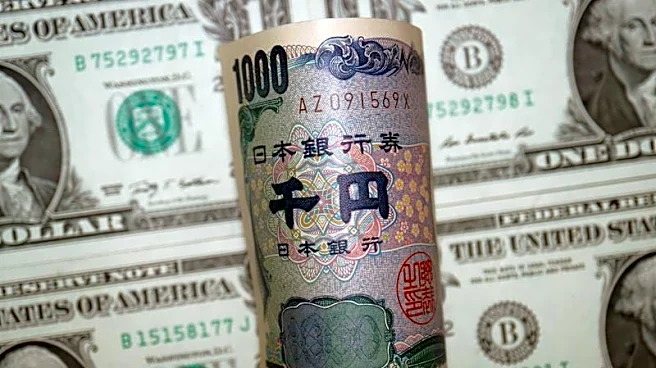
Japan executed a record single-day yen-buying intervention on July 30, spending 7.98 trillion yen (approximately 50.4 billion U.S. dollars) to bolster its currency in the foreign exchange market. This intervention was part of a larger series of yen-buying,
dollar-selling operations conducted on July 30, July 31, and August 3, totaling 15.4 trillion yen, according to data released by the Finance Ministry. The interventions were prompted by the yen's depreciation to the upper 163 range against the U.S. dollar in late July, marking its weakest level in approximately 40 years. On July 31, Japan and the United States also engaged in a coordinated intervention to support the yen, their first such joint effort in 28 years, with Japan contributing 5.55 trillion yen. These measures initially caused the yen to strengthen, reaching the lower 155 range against the U.S. dollar by August 3 and briefly firming to the 152 range on September 8. However, the yen subsequently lost these gains, primarily due to the persistent interest rate differential between Japan and the United States, and has recently been trading around the 158 range against the U.S. dollar.
Why It's Important?
Japan's record intervention highlights the significant challenges faced by countries with diverging monetary policies from the United States. For the U.S. economy, a strong dollar, partly driven by higher interest rates compared to Japan, can make American goods more expensive for international buyers, potentially impacting export-oriented industries. Conversely, it makes imports cheaper, which can benefit U.S. consumers but also put pressure on domestic producers. The coordinated intervention with the U.S. underscores the global implications of currency stability and the potential for international cooperation to address extreme market volatility. However, the yen's subsequent weakening despite these efforts demonstrates the powerful influence of interest rate differentials. This situation can affect U.S. companies with significant operations or investments in Japan, as their earnings in yen would translate to fewer dollars. It also impacts U.S. investors holding Japanese assets, as the value of those assets can be eroded by currency depreciation.
What's Next?
The persistent interest rate differential between Japan and the United States remains a critical factor influencing the yen's value. As long as the U.S. maintains higher interest rates compared to Japan, the yen is likely to face continued downward pressure. Future interventions by Japan's Finance Ministry are possible if the yen experiences further significant depreciation, though the effectiveness of such interventions may be limited without a shift in underlying monetary policy. The U.S. Federal Reserve's future interest rate decisions will therefore be closely watched by global markets, as they will directly impact the dollar-yen exchange rate. Any changes in the Federal Reserve's stance on interest rates, or a shift in the Bank of Japan's ultra-loose monetary policy, could significantly alter the currency's trajectory. Additionally, global economic conditions and geopolitical stability will continue to play a role in investor sentiment and currency flows.
Beyond the Headlines
The situation with the Japanese yen and its interventions against the U.S. dollar reveals a broader tension in global finance: the challenge of maintaining currency stability in an era of divergent monetary policies. While interventions can provide temporary relief, they often struggle against fundamental economic forces like interest rate differentials. This scenario raises questions about the limits of unilateral and even coordinated currency interventions. For the U.S., a persistently strong dollar can have both benefits and drawbacks, influencing trade balances, inflation, and the competitiveness of American industries. The episode also highlights the potential for currency movements to become a political issue, especially when they impact trade relationships and economic stability. The long-term implications could include increased calls for international policy coordination to address currency imbalances, or a greater focus on domestic economic resilience to mitigate the effects of global currency fluctuations.