





What's Happening?
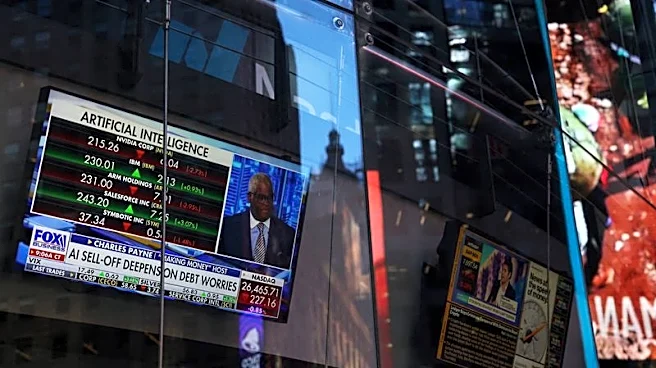
Wall Street's current stock market rally, driven by advancements in Artificial Intelligence (AI) and quantum computing, faces a significant threat from a $1.5 trillion margin debt bubble. According to FINRA, outstanding margin debt reached an all-time
high of $1.502 trillion in June 2026, representing a 77% increase over the 14-month period from April 2025. Margin debt refers to money investors borrow from brokers to purchase securities, acting as a form of leverage. Historically, rapid surges in margin debt have preceded substantial bear markets. Previous instances where margin debt climbed by at least 65% over a short period (12 to 19 months) coincided with the dot-com bubble burst in 2000, the financial crisis in 2007, and the 2022 bear market following the COVID-19 crash. This pattern suggests that outsized risk-taking, as indicated by high margin debt, is a critical red flag for the stock market.
Why It's Important?
The $1.5 trillion margin debt bubble is a critical concern because it signifies an elevated level of risk-taking among investors, which has historically led to significant market downturns. When investors use borrowed money to amplify gains, they also magnify potential losses if the market moves unfavorably. A sudden market correction, potentially triggered by a bursting of the AI or quantum computing bubbles, could force investors to sell off assets to cover margin calls, leading to a rapid and severe market decline. This could erase the gains from the current four-year bull market and impact a broad range of investors, from individual traders to institutional funds. The current situation is particularly precarious given that the stock market is considered historically expensive, making it more vulnerable to such a correction. The potential for a bear market would affect retirement accounts, investment portfolios, and overall economic confidence, with ripple effects across the U.S. financial system.
What's Next?
Investors and market analysts will be closely watching for signs of a potential margin debt-induced market correction. While the exact timing and catalyst for such an event are unpredictable, the historical precedent suggests that a significant downturn could be on the horizon. Investors might consider re-evaluating their risk exposure and potentially reducing their reliance on margin. Regulators and financial institutions may also increase scrutiny on margin lending practices to mitigate systemic risks. Should a correction occur, it would likely present a challenging period for short-term investors but could also create 'generational buying opportunities' for patient, long-term investors, as historical data suggests that the S&P 500 has always generated positive returns over any 20-year period, even when investing at market peaks. The market's response to any future economic or technological shifts will be critical in determining if this historical pattern of margin debt leading to bear markets repeats.
Beyond the Headlines
The phenomenon of the margin debt bubble extends beyond mere financial metrics, touching upon the psychological and behavioral aspects of investing. The rapid increase in margin debt reflects a collective investor euphoria and a willingness to take on excessive risk, often fueled by the promise of 'next-big-thing' technologies like AI and quantum computing. This mirrors past speculative bubbles, where the allure of quick profits overshadowed fundamental valuations and risk management. The potential bursting of this bubble could serve as a stark reminder of the cyclical nature of market sentiment and the dangers of leverage. It also highlights the ongoing challenge for regulators to balance market innovation with financial stability. Furthermore, a significant market correction could lead to a broader re-evaluation of investment strategies, emphasizing long-term value and diversification over speculative growth, and potentially shifting capital flows towards more stable assets. This event could reshape investor behavior and market dynamics for years to come.