






What's Happening?
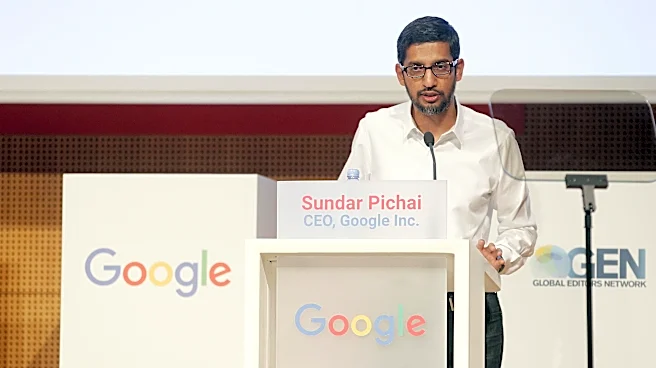
Alphabet CEO Sundar Pichai announced the launch of the Gemini Decisions API on November 11, 2026. This new artificial intelligence product is powered by the Gemini Decision 1 model and is designed for closed-set choices, capable of scoring up to 1,000
questions across various data types including text, images, audio, video, and PDFs in a single pass. The API offers three decision types: yes/no, multiple choice (up to 255 options), and rubric scoring. Pichai detailed a competitive pricing model of $0.10 per 1 million input tokens, with output tokens being free, which is approximately five times cheaper than Flash-Lite. This launch occurs amidst rapid growth and increasing competition within the artificial intelligence sector, with other AI firms also experiencing significant revenue growth and strong investor interest. Google teams are already utilizing the Gemini Decisions API, with examples such as Stitch Rapid designing full product flows in seconds.
Why It's Important?
The introduction of the Gemini Decisions API with its aggressive pricing strategy signifies Alphabet's intent to capture a larger share of the burgeoning AI market. By offering a cost-effective solution for AI decision-making, Alphabet aims to attract developers and enterprises seeking efficient and accurate AI models for specific, closed-set tasks. This move could intensify competition among major AI players, potentially driving down costs and accelerating innovation across the industry. The API's ability to process diverse data types and handle a large volume of questions in a single pass could significantly enhance the efficiency of AI-powered applications in various sectors, from automated customer service to complex data analysis. The competitive pricing model also makes advanced AI capabilities more accessible to a broader range of businesses, including startups, which could foster a more dynamic and innovative AI ecosystem.
What's Next?
The launch of the Gemini Decisions API is expected to spur further adoption of Alphabet's AI offerings among developers and businesses. The competitive pricing and claimed performance advantages, such as leading on benchmark evaluations with low calibration error, could lead to increased integration of this API into new and existing applications. Other AI companies may respond by adjusting their own pricing models or accelerating their product development to maintain competitiveness. The broader AI market will likely see continued rapid expansion, with a focus on specialized AI models that offer cost-effective and efficient solutions for specific business needs. As Google teams are already building with the API, more practical applications and use cases are likely to emerge, demonstrating its real-world utility and potentially influencing future AI development trends.
Beyond the Headlines
This development underscores a broader trend in the AI industry towards specialized, highly efficient models designed for specific tasks rather than general-purpose AI. The focus on 'closed-set choices' suggests a strategic move to address particular business needs where clear, definitive answers are required, potentially reducing the complexity and computational overhead associated with generative AI. The competitive pricing model also highlights the increasing commoditization of certain AI capabilities, indicating that access to powerful AI tools is becoming more widespread and affordable. This could democratize AI development, allowing smaller entities to leverage advanced AI without prohibitive costs. Furthermore, the ability to process diverse data types in a single pass points to advancements in multimodal AI, where models can seamlessly integrate and interpret information from various sources, paving the way for more sophisticated and context-aware AI applications.