


What's Happening?
The U.S. dollar has softened from its recent highs, a development that typically would offer some relief to commodities like gold and silver. However, according to Kitco NewsWire, this decline in the dollar, coupled with falling Treasury yields, has provided
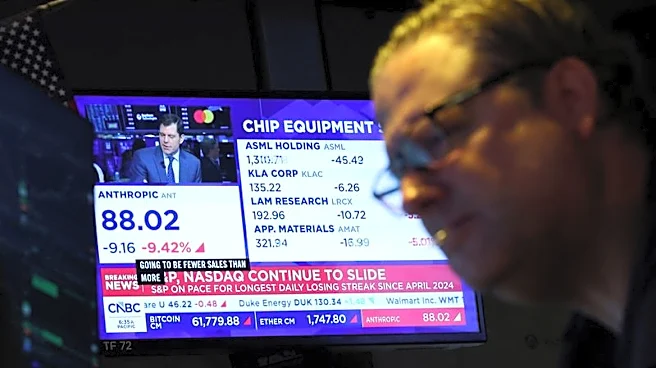
little support to precious metals. Gold and silver prices continued their selloff on Friday, with gold approaching the $3,500 level and silver experiencing even heavier losses. This trend is attributed to a technology-led equity market decline and expectations of additional Federal Reserve interest rate increases. Investors are reducing exposure to risk assets, leading to a broader portfolio liquidation that is impacting precious metals despite improving inflation expectations and a weaker dollar. The benchmark 10-year U.S. Treasury yield declined towards 4.94%, and the two-year yield eased near 4.65%, reflecting strong demand for government securities during the equity market selloff.
Why It's Important?
The current market dynamics highlight a significant shift in investor behavior, where traditional relationships between asset classes are being overridden by broader economic concerns. The U.S. dollar's softening, which usually makes dollar-denominated assets more attractive to international buyers, is failing to bolster precious metals. This indicates that the prevailing sentiment is one of risk aversion and liquidation across various asset classes, rather than a strategic reallocation. The continued decline in gold and silver, despite a weaker dollar and lower Treasury yields, suggests that investors are prioritizing capital preservation and liquidity in the face of equity market volatility and uncertainty regarding the Federal Reserve's monetary policy. This could signal deeper concerns about economic growth and financial stability, impacting investment strategies across U.S. markets and potentially leading to further volatility in commodity prices.
What's Next?
Investors are now looking to upcoming economic data, including Monday's preliminary November purchasing managers' indexes and the Chicago Fed National Activity Index, along with additional Federal Reserve commentary. These releases will provide further signals about the strength of economic activity and the outlook for interest rates. The Federal Reserve's Dec. 8-9 policy meeting remains a key focus, with expectations for a 25-basis-point interest rate hike in December, although the possibility of a larger 50-basis-point increase has diminished. The ongoing instability in the Strait of Hormuz and the U.S.-Iran situation continue to pose geopolitical risks to petroleum exports, which could influence crude oil prices and, indirectly, broader market sentiment. The trajectory of inflation and the Federal Reserve's response will be critical in determining the future direction of the U.S. dollar, precious metals, and equity markets.
Beyond the Headlines
The divergence between falling Treasury yields and declining bullion prices suggests that the market is grappling with a complex interplay of factors beyond simple interest-rate relationships. The widespread liquidation of assets, including precious metals, points to a systemic de-risking by investors. This could have long-term implications for the role of gold as a safe-haven asset, particularly if its traditional inverse relationship with the dollar and interest rates continues to weaken. The emphasis on artificial intelligence valuations and the technology sector's impact on the broader market also highlights a potential vulnerability, where a concentrated selloff in one sector can trigger wider market instability. This scenario underscores the interconnectedness of global financial markets and the challenges policymakers face in managing inflation and economic growth amidst evolving technological and geopolitical landscapes.