
What's Happening?
In Tützpatz, Germany, the Swedish utility Vattenfall has successfully developed a 76-megawatt agrivoltaic solar park across 230 acres, integrating solar panel arrays with active agriculture, including 15,000 laying hens and a four-crop rotation. This
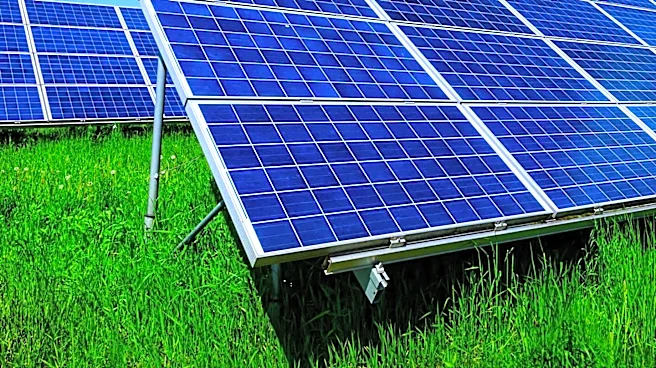
project was built without government subsidies, a notable achievement attributed to a power purchase agreement with Deutsche Telekom AG's subsidiary, PASM, which will buy the entire output for ten years. The project adheres to German law, specifically DIN SPEC 91434, which mandates that land under agrivoltaic installations must maintain at least 66% of its reference agricultural yield to be considered a farm. Tützpatz features two types of integration: fixed racking for livestock (Tützpatz 1) and single-axis trackers for crops (Tützpatz 2 and 3) that can rotate vertically to allow agricultural machinery, like combines, to pass through. This design ensures that farming operations can continue effectively beneath and between the panels.
Why It's Important?
This German success story holds significant implications for the U.S. agricultural and renewable energy sectors. In the U.S., there's a growing tension between solar development and farmland preservation, with many counties banning data centers and large-scale solar projects on agricultural land. The Tützpatz model demonstrates a viable path for commercial-scale agrivoltaics that genuinely integrates farming, rather than merely co-locating it. This could offer a solution to the 'either-or' dilemma faced by many U.S. farmers considering solar leases, potentially allowing them to generate significant income from solar while continuing to farm. The absence of subsidies in the Tützpatz project suggests that such integrated systems can be economically self-sustaining, making them more attractive for private investment. If U.S. states or counties adopt similar agricultural yield thresholds, it could drive innovation in agrivoltaic design and deployment, ensuring that renewable energy expansion does not come at the expense of food production. This could also create new economic opportunities for farmers and contribute to a more sustainable energy transition.
What's Next?
The Tützpatz project, particularly its adherence to the 66% agricultural yield threshold, could serve as a blueprint or a strong case study for U.S. policymakers and developers. While some U.S. counties and states are beginning to incorporate agricultural conditions into solar permits, none currently enforce a specific yield percentage like Germany. The next steps in the U.S. might involve legislative efforts to define agrivoltaics more formally and to establish measurable agricultural performance standards for such projects. This could encourage more sophisticated agrivoltaic designs that genuinely support farming, moving beyond simpler integrations like pollinator habitats or sheep grazing. Developers in the U.S. might also explore similar power purchase agreements with large corporations to finance subsidy-free agrivoltaic projects. The long-term success of the Tützpatz project, particularly its published harvest data, will be crucial in validating the economic and agricultural viability of this model and influencing its adoption globally.
Beyond the Headlines
The Tützpatz project transcends mere energy production; it represents a paradigm shift in land use and resource management. It challenges the conventional notion that agriculture and large-scale renewable energy are mutually exclusive, offering a vision of synergistic land utilization. This has profound ethical and environmental implications, as it addresses concerns about food security, biodiversity, and climate change simultaneously. By demonstrating that solar farms can be 'farms' in a meaningful sense, it could foster greater public acceptance of renewable energy infrastructure, especially in rural communities often resistant to industrial-scale solar developments. The project also highlights the importance of regulatory frameworks, like Germany's DIN SPEC 91434, in driving innovation and ensuring genuine sustainability. Without such standards, 'agrivoltaics' could become a greenwashing term, failing to deliver on its promise. The success of Tützpatz underscores the potential for integrated solutions to complex environmental and economic challenges, offering a model for a more resilient and sustainable future.