
What's Happening?
A new study by Professor Miyuri Shirai of Keio University, Japan, reveals that consumers' evaluations of sustainable products are significantly influenced by their 'green consumption values' (GCVs). The
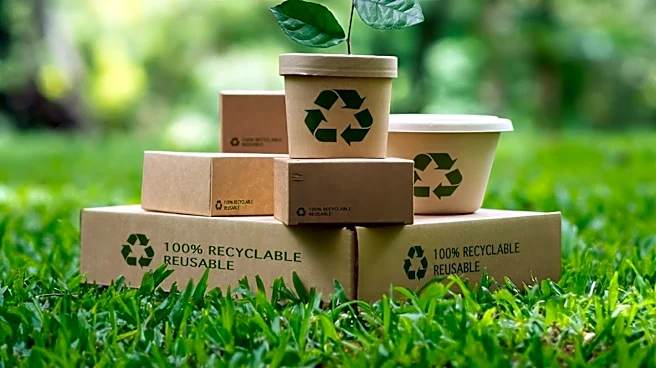
research, published in the Journal of Environmental Psychology, found that highlighting multiple sustainability benefits (e.g., in both product composition and packaging) does not universally improve how consumers perceive a product. Consumers with high GCVs, who prioritize environmentally responsible consumption, responded more favorably when sustainability was communicated through both composition and packaging. Conversely, participants with lower GCVs preferred messages that focused on a single sustainable attribute. The study, conducted across three product categories (laundry detergent, organic granola, and body wash) in Japan with a combined sample of 1,729 participants, suggests that companies marketing sustainable consumer goods need to tailor their communication strategies to their target audience's environmental values, rather than assuming more claims are always better.
Why It's Important?
This research has significant implications for U.S. consumer-packaged goods (CPG) companies and their marketing strategies for sustainable products. As consumer demand for eco-friendly options grows, understanding how different segments of the population interpret and value sustainability claims is crucial. Misaligned communication can lead to ineffective marketing campaigns, wasted resources, and potentially alienate segments of the consumer base. For companies, tailoring messages can optimize engagement and sales, ensuring that their sustainability efforts resonate with the intended audience. For consumers, clearer and more targeted communication can help them make more informed purchasing decisions that align with their personal values. This study underscores the need for market research to identify the GCVs of target demographics and adjust messaging accordingly, moving beyond a one-size-fits-all approach to sustainability marketing.
What's Next?
Companies marketing sustainable products will likely need to refine their communication strategies to be more nuanced and audience-specific. This could involve segmenting their consumer base based on green consumption values and developing different marketing messages for each group. For instance, highly environmentally conscious consumers might appreciate detailed information about both product and packaging sustainability, while less engaged consumers might prefer simpler, single-attribute claims. Further research is needed to explore these patterns in different product categories and consumer populations, including in the U.S., and to determine if tailored messaging translates into actual purchasing behavior. The study also suggests that the perceived usefulness of sustainability information and perceived product sustainability play a role, indicating that future efforts might focus on enhancing these perceptions through targeted communication.
Beyond the Headlines
The findings of this study highlight a deeper psychological aspect of consumer behavior related to sustainability: the 'embedding effect,' where adding more positive information doesn't always make an option seem better. This suggests that consumers, particularly those less invested in environmental issues, may experience information overload or skepticism when presented with too many sustainability claims, potentially perceiving them as greenwashing. This raises ethical questions for marketers about the responsibility to educate consumers versus simply appealing to their existing values. It also points to the need for a broader societal shift in environmental awareness, where more consumers develop higher GCVs, making them more receptive to comprehensive sustainability messaging. Ultimately, effective communication about sustainable products is not just about conveying facts, but about building trust and fostering a genuine connection with consumers' evolving environmental consciousness.