
What's Happening?
Rigetti Computing, Inc. (RGTI), a full-stack quantum computing company, has experienced a significant stock price decline of approximately 35% over the past 30 days, falling from $12.40 to $8.04. This
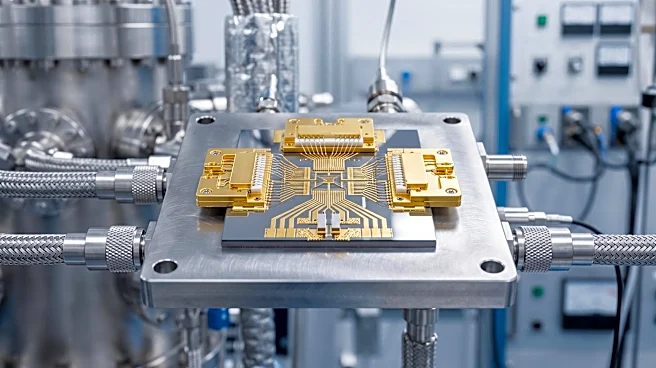
downturn follows the company's third-quarter 2026 earnings report, which revealed revenue of $1.41 million, substantially missing the consensus estimate of $3.52 million. The adjusted loss per share was $0.06, wider than the expected $0.05. No hardware revenue was recognized during this period, contributing to a 27.5% year-over-year revenue decline. Operating losses widened to $33.2 million from $20.5 million a year prior, primarily due to increased research and development spending. Despite the financial setbacks, Rigetti achieved a 99.5% median two-qubit gate fidelity on its 108-qubit Cepheus-1-108Q system, surpassing its year-end goal. The company also secured a definitive agreement with the U.S. Department of Commerce for up to $100 million in funding for superconducting research, in exchange for a minority equity stake.
Why It's Important?
The sharp decline in Rigetti Computing's stock price reflects a broader valuation reset within the quantum computing sector, rather than a deterioration of its technological roadmap. The market is increasingly demanding faster conversion of technological milestones into recognized revenue, highlighting a timing gap between achievement and customer acceptance. This shift in investor sentiment, coupled with macro conditions such as rising Treasury yields and hotter inflation data, has disproportionately affected pre-revenue, cash-consuming technology businesses. The company's performance is closely watched as a pure-play proxy for superconducting quantum computing, making its financial results and technological advancements critical indicators for the nascent industry. The U.S. Department of Commerce funding underscores the strategic importance of quantum computing to national interests, providing a financial cushion but also diluting existing equity.
What's Next?
The immediate focus for Rigetti Computing is the fourth-quarter recognition of an $8.4 million C-DAC system for India's Centre for Development of Advanced Computing. Successful acceptance of this system is crucial for validating the company's full-year revenue target of approximately $20 million; any delay would push the shortfall into fiscal year 2027. Management anticipates selling four to six systems in 2027, making order flow and backlog disclosures significant for future investor confidence. Investors will also monitor capital spending, which is expected to remain consistent with 2026 levels as Rigetti invests in higher-capacity dilution refrigerators and Fab-1 equipment. On the technology front, progress toward the 300-plus qubit milestone and advancements in error-correction work are key long-term indicators. External factors such as Treasury yields, inflation data, and Federal Reserve policy will continue to influence long-duration growth equities, including Rigetti.
Beyond the Headlines
The challenges faced by Rigetti Computing highlight the inherent difficulties in commercializing cutting-edge technologies like quantum computing. While the company is making significant technological strides, as evidenced by its qubit fidelity achievements, the market's impatience for tangible revenue generation underscores the long development cycles and substantial capital requirements of this industry. The CEO's acknowledgment that quantum computing is still in the research and development phase, with a three-year horizon for demonstrating ROI against classical computing, sets realistic expectations but also tests investor patience. This situation reflects a broader tension between technological innovation and market demands for immediate financial returns, a common theme in emerging tech sectors. The U.S. government's investment through the CHIPS Act signals a strategic commitment to domestic quantum capabilities, recognizing its potential for national security and economic competitiveness, even as commercial viability remains a future prospect.