






What's Happening?
Anthropic, a prominent U.S. AI company, is urging U.S. regulators to crack down on what it terms 'illegal distillation attacks' by Chinese AI companies. Anthropic claims that Chinese firms are concealing their identities and using stolen account credentials
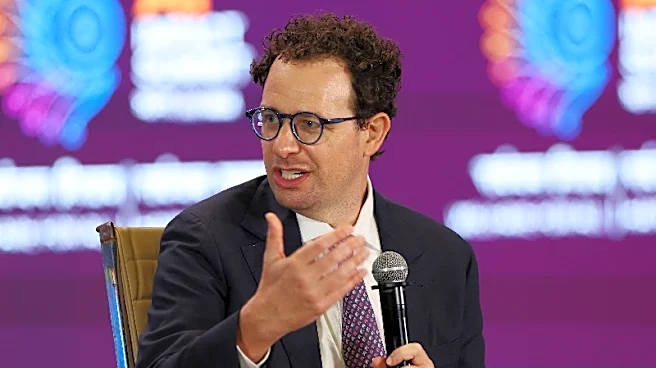
to unauthorizedly distill its Claude model. Dario Amodei, CEO of Anthropic, has publicly advocated for these measures, including banning the sale of advanced AI chips and semiconductor manufacturing equipment to China, increasing efforts against smuggling, and blocking remote access from China to overseas data centers. Amodei argues that distillation allows latecomer companies to close the technology gap at a significantly lower cost than independent development. He believes that implementing these measures could 'slow China's progress sufficiently to significantly widen America's lead within the next three to five years.' This stance is in contrast to Y Combinator CEO Garry Tan, who, while opposing distillation using stolen accounts, argues that U.S. open-weight companies should be permitted to distill domestic frontier models to reduce dependence on Chinese-made models.
Why It's Important?
This call for a regulatory crackdown highlights a critical and evolving challenge in the U.S.-China technology competition, particularly in the field of artificial intelligence. The practice of 'distillation,' where large AI models are used to train smaller ones, raises significant intellectual property concerns and could undermine the competitive advantage of U.S. AI developers. If Chinese companies can rapidly advance their AI capabilities by distilling U.S. models without authorization, it could erode America's technological lead, impacting national security, economic competitiveness, and future innovation. The proposed measures, such as export bans on advanced chips and restrictions on data center access, would represent a significant escalation in U.S. efforts to control technology transfer to China. This debate also exposes a rift within the U.S. AI industry regarding the balance between protecting intellectual property and fostering an open-weight AI ecosystem, with potential implications for the future direction of AI development and regulation in the U.S.
What's Next?
The debate between Anthropic and Y Combinator signals a likely increase in discussions and potential policy actions by U.S. regulators concerning AI model distillation and technology transfer to China. Regulators will need to consider the implications of 'illegal distillation attacks' on intellectual property rights and national security, potentially leading to new regulations or enforcement mechanisms. The proposals for banning advanced AI chip sales and restricting data center access could be explored further by government bodies, potentially leading to stricter export controls and cybersecurity measures. The outcome of this debate could shape the future landscape of AI development, influencing how U.S. companies protect their proprietary models and how international collaborations in AI are structured. It may also prompt a re-evaluation of existing intellectual property laws in the context of rapidly evolving AI technologies. The U.S. government will likely face pressure to balance the need for technological leadership with the desire to maintain an open and innovative AI research environment.
Beyond the Headlines
The controversy surrounding AI model distillation by China delves into deeper ethical and strategic considerations beyond immediate regulatory actions. The concept of 'illegal distillation attacks' raises fundamental questions about intellectual property in the age of AI, where the lines between inspiration, reverse engineering, and outright theft can be blurred. It also highlights the broader geopolitical struggle for technological supremacy, with AI being a key battleground. The U.S. response to these challenges will not only define its relationship with China in the tech sector but also set precedents for international norms around AI development and data governance. The tension between open-source principles, advocated by some in the AI community, and the need for proprietary protection, as argued by Anthropic, reflects a fundamental philosophical divide. The long-term implications could include a more fragmented global AI ecosystem, with different regions adopting distinct regulatory frameworks and technological standards, potentially hindering global collaboration on AI safety and ethical development.