








What's Happening?
Astroscale, a satellite servicing company based in Tokyo, has announced a significant capital infusion to transition from technology demonstrations to regular mission operations. The company reported a project income of 11.5 billion yen ($71.1 million)
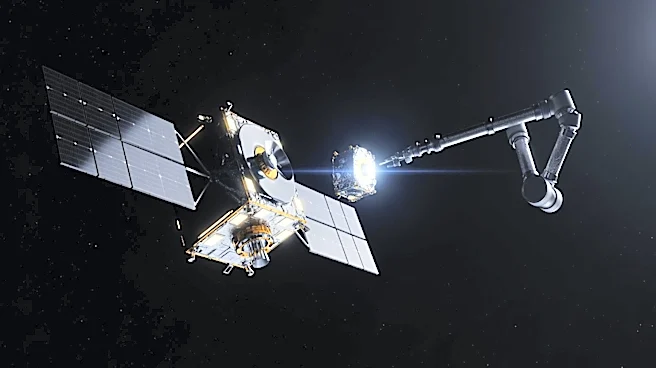
for its 2026 fiscal year, nearly doubling its previous year's income. Despite an operating loss of 10 billion yen, this marks an improvement from the prior year's loss. The new funding, amounting to 30.6 billion yen, will be used to expand production facilities in Japan and the UK, and to manufacture the LEXI-P spacecraft. Astroscale aims to establish a supply capacity that supports repeatable business, particularly in defense and commercial sectors, with a focus on satellite life-extension services.
Why It's Important?
Astroscale's strategic shift from demonstration missions to commercial operations represents a significant development in the space industry, particularly in the emerging field of on-orbit servicing. This move positions Astroscale as a first mover in securing projects and building operational track records, which is crucial for long-term competitive advantage. The company's focus on defense customers and satellite life-extension services highlights the growing demand for space domain awareness and spacecraft refueling. This expansion could lead to increased market opportunities and solidify Astroscale's position as a leader in the space servicing sector, potentially influencing industry standards and practices.
What's Next?
Astroscale plans to execute several missions in the next two years, including a refueling mission for the U.S. Space Force and a demonstration of end-of-life satellite disposal. These missions are expected to solidify the company's market position and expand its repeatable business. The company is also negotiating with potential customers for its LEXI-P spacecraft, with the first mission planned for its 2028 fiscal year. As Astroscale continues to strengthen its capabilities in talent, development, and production, it anticipates steady revenue growth and aims to make on-orbit servicing commonplace by 2030.