






What's Happening?
Ahead of its second-quarter earnings report, Nvidia is drawing investor attention to its newly announced $500 billion financing platform for AI customers. This platform, developed in collaboration with financial partners, aims to support data center projects
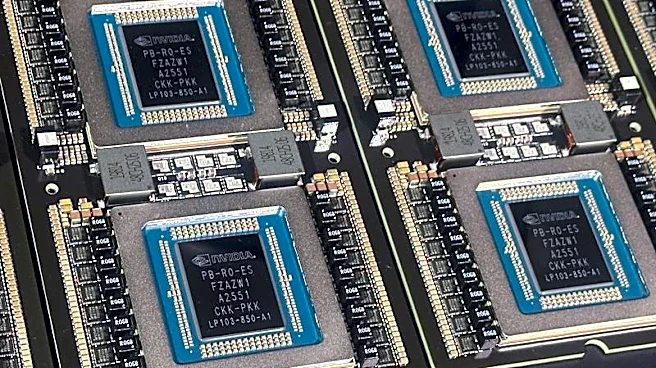
for AI labs, businesses, and cloud providers. Goldman Sachs analysts, led by James Schneider, anticipate that investors will closely scrutinize the details of this financing initiative. The company's involvement could include guaranteeing up to 25% of a project's value, subject to individual review. Additionally, investors are keen on the rollout of Nvidia's new Rubin chip generation, slated to begin in the third quarter, and the impact of rising memory costs on profit margins. The margin has been above 75% for the past two quarters but is now under pressure. Reports suggest Nvidia might reduce the proportion of HBM memory in some Rubin servers by up to half. The demand for pure CPU racks for agentic AI applications, expected to ship in the second half of the year, and increasing competition from AMD's Helios systems are also on the watch list.
Why It's Important?
Nvidia's strategic move into financing AI infrastructure highlights a significant shift in the technology sector, where the cost and scale of AI development are becoming critical barriers. By offering financial support, Nvidia aims to accelerate the adoption of its hardware and maintain its dominant position in the AI chip market. This initiative could significantly impact the U.S. technology industry by fostering innovation and growth in AI, potentially leading to new applications and services. However, the extent of Nvidia's financial commitment and its potential impact on the company's stock buybacks and dividends are key concerns for investors. A strong financial performance and clear guidance on the financing platform could boost investor confidence and further solidify Nvidia's market leadership. Conversely, any perceived overextension or negative impact on profitability could lead to market skepticism. The competition from AMD's Helios systems also underscores the dynamic nature of the AI hardware market, where continuous innovation and strategic partnerships are crucial for sustained success.
What's Next?
Investors will be closely watching Nvidia's upcoming earnings call for detailed insights into the $500 billion AI financing platform. Specifics regarding the financial commitments, risk assessment, and potential impact on the company's balance sheet will be critical. The company's guidance on the rollout of the Rubin chip generation in the third quarter will also be a major focus, as this new technology is expected to drive future revenue growth. Furthermore, Nvidia's strategy to manage rising memory costs and maintain its profit margins will be under scrutiny. Any announcements regarding the reduction of HBM memory in Rubin servers or plans for pure CPU racks for agentic AI applications will provide further clarity on the company's product roadmap. The market will also be looking for Nvidia's response to the growing competition from AMD's Helios systems, which could influence future market share and pricing strategies. Goldman Sachs anticipates a strong quarter for Nvidia, with their estimates for revenue and earnings per share significantly exceeding market consensus.
Beyond the Headlines
Nvidia's foray into financing AI infrastructure extends beyond a simple business transaction; it signifies a deeper integration of hardware providers into the entire AI ecosystem. This move could set a precedent for other technology companies, blurring the lines between hardware manufacturing, financial services, and strategic partnerships. The ethical implications of a single company holding significant financial sway over the development of AI labs and cloud providers warrant consideration, as it could influence the direction and accessibility of AI innovation. Furthermore, the long-term shift towards 'agentic AI applications' suggests a future where AI systems are more autonomous and capable of complex decision-making, raising questions about governance, accountability, and societal impact. The increasing cost of high-bandwidth memory (HBM) also highlights a critical supply chain vulnerability in the AI industry, potentially leading to strategic shifts in hardware design and manufacturing. This could trigger a broader industry discussion on diversifying component suppliers and investing in domestic production capabilities to mitigate future risks.