





What's Happening?
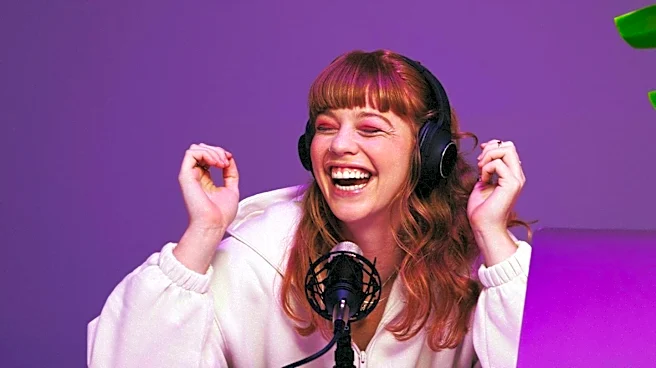
Content creator and model Nara Smith recently appeared on the 'Call Her Daddy' podcast, hosted by Alex Cooper, to discuss and refute the 'tradwife' label that the internet has attributed to her. Smith, who has gained a significant following on TikTok
for her videos featuring homemade cooking in designer clothing, clarified that her lifestyle does not align with the traditional definition of a 'tradwife.' She highlighted her professional career, which began with modeling at age 14 and now includes running a successful content business. Smith also revealed that her husband, Lucky Blue Smith, handles household chores like doing the dishes, and that childcare responsibilities are equally shared between them. She explained that her passion for cooking stems from a genuine love for it and a need to manage an autoimmune disease, rather than fulfilling a prescribed gender role.
Why It's Important?
This discussion is important as it challenges prevailing online narratives and stereotypes, particularly those surrounding women's roles and domesticity. Nara Smith's clarification on the 'Call Her Daddy' podcast underscores the potential for misinterpretation and mislabeling in the digital age, where curated online content can lead to broad assumptions about individuals' private lives. For society, it highlights the ongoing debate about gender roles and the 'tradwife' movement, emphasizing that personal choices and professional ambitions often coexist with domestic activities. It also brings to light the impact of online commentary on individuals' careers and opportunities, as Smith mentioned the label had cost her professional engagements. This conversation encourages a more nuanced understanding of public figures and the complexities of their lives beyond what is presented on social media platforms.
Beyond the Headlines
Nara Smith's interview on 'Call Her Daddy' delves into deeper societal implications regarding the intersection of personal branding, gender expectations, and online perception. The 'tradwife' label, often associated with anti-feminist ideologies, was applied to Smith based on a superficial interpretation of her content. Her detailed explanation reveals the disconnect between online appearances and real-life dynamics, particularly concerning labor division within a household and individual career aspirations. This incident highlights the ethical responsibility of online audiences to avoid making sweeping judgments based on limited information. It also underscores the cultural pressure on women to conform to certain archetypes, even when their lives are far more complex and professionally driven. The conversation serves as a reminder that behind every online persona is an individual with a multifaceted life, and that assumptions can have tangible negative consequences on their personal and professional well-being.