






What's Happening?
Ernst & Young (EY), a prominent professional services and accounting firm, is launching a new $100 million rewards program designed to incentivize employees who demonstrate strong 'human skills' such as adaptability, innovation, and judgment. This initiative
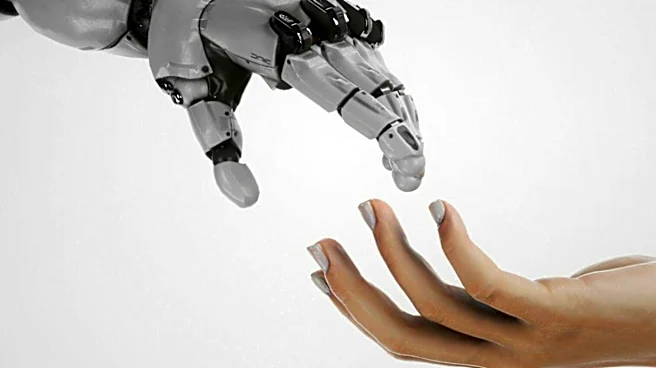
comes as artificial intelligence (AI) increasingly automates routine tasks within the business sector. The program aims to counteract a perceived deficit in uniquely human attributes that remain crucial for business success. Employees can receive 'spot' awards of up to $500 for individual contributions, while teams and individuals making a significant impact on the firm can earn cash awards ranging from $10,000 to $25,000. The program allows co-workers at any level to nominate their peers, with no cap on the total amount an employee can earn from these bonuses. This investment is part of EY's broader strategy to attract and retain talent in a rapidly evolving market, which also includes a 12-month 'career residency' program to enhance mentorship.
Why It's Important?
This investment by EY highlights a significant shift in the professional services industry's approach to workforce development in the age of AI. As AI technologies become more sophisticated and capable of handling complex analytical and repetitive tasks, the value of uniquely human skills is being re-evaluated and prioritized. For the U.S. business landscape, this move by a major firm like EY could set a precedent, encouraging other companies to invest in fostering soft skills among their employees. This could lead to a broader redefinition of essential job competencies, emphasizing creativity, critical thinking, and interpersonal abilities over purely technical or analytical prowess that AI can replicate. The initiative also addresses the challenge of talent attraction and retention in a competitive market, suggesting that companies are recognizing the need to offer more than just traditional compensation to secure a balanced and future-ready workforce. This could influence educational curricula and corporate training programs to focus more on developing these 'uniquely human' attributes.
What's Next?
EY's new rewards program is expected to roll out, with employees becoming eligible for the various bonus tiers based on their demonstration of targeted human skills and contributions. The firm will likely monitor the program's effectiveness in fostering these skills and its impact on employee engagement and retention. Other professional services firms and businesses across various sectors may observe EY's outcomes closely, potentially leading to similar initiatives to adapt their workforces to the AI era. This could spark a trend of increased investment in human-centric skills development and new compensation models that recognize contributions beyond traditional metrics. The success of this program could also influence how companies structure their talent acquisition strategies, placing a greater emphasis on assessing and cultivating these non-automatable skills during recruitment and career progression.
Beyond the Headlines
Beyond the immediate financial incentives, EY's program touches upon deeper ethical and cultural implications for the future of work. By explicitly valuing skills that AI cannot replicate, EY is implicitly acknowledging the irreplaceable role of human judgment and creativity in a technology-driven world. This could lead to a more humanized corporate culture, where empathy, collaboration, and ethical decision-making are not just buzzwords but tangible assets rewarded by the organization. The initiative also raises questions about the long-term impact of AI on employment and the evolving relationship between humans and machines in the workplace. It suggests a future where human workers are not replaced by AI, but rather augmented by it, focusing on higher-order cognitive and emotional tasks. This shift could foster a more resilient and adaptable workforce, capable of navigating continuous technological disruption and maintaining a competitive edge in the global economy.