




What's Happening?
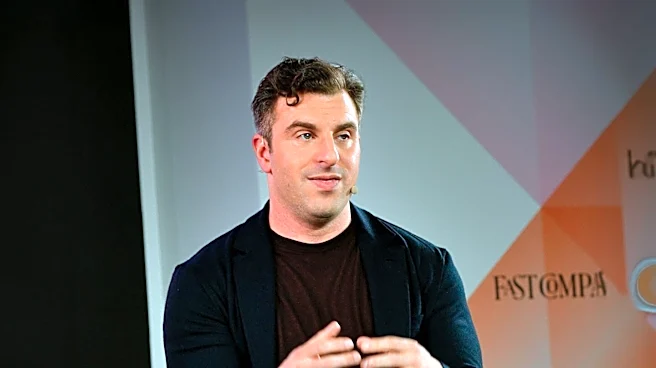
Brian Chesky, the billionaire CEO of Airbnb, has acknowledged that some of his employees might perceive him as a 'control freak.' He attributes this approach to his study of Apple co-founder Steve Jobs' leadership methods. Chesky noted that Jobs was known
for holding people to high standards, being deeply involved in details, and spending significant time on recruitment. When asked if Airbnb staff would describe him similarly, Chesky responded, 'I think some people do.' He dedicates three hours daily to recruiting and advises hiring managers to leave if they disagree with his input. However, Chesky maintains that his involvement is not micromanagement but rather a form of 'partnering' to help employees think bigger and make faster decisions. He cited a conversation with Jony Ive, Apple's former design chief, who stated he never felt micromanaged by Jobs, but rather that they were 'constantly partnering' and working back and forth on details.
Why It's Important?
Chesky's leadership philosophy, influenced by Steve Jobs, highlights a significant debate in corporate management regarding the balance between detailed involvement and employee autonomy. For U.S. businesses, particularly in the tech and startup sectors, this approach could influence how leadership is perceived and practiced. Companies might evaluate whether a 'founder mode' style, characterized by deep engagement in product, marketing, and operations, fosters innovation and efficiency or stifles creativity and empowers employees. The emphasis on rapid decision-making by a leader, as described by Chesky, could be seen as a way to cut through bureaucratic layers, potentially accelerating product development and market response. Conversely, a perception of excessive control could impact employee morale, retention, and the development of future leaders within an organization. This discussion is crucial for understanding modern leadership dynamics in high-growth companies.
What's Next?
The ongoing discussion around Brian Chesky's leadership style and its comparison to Steve Jobs' approach is likely to continue influencing management practices within Airbnb and potentially other U.S. tech companies. As Airbnb continues to grow and evolve, the effectiveness of this 'partnering' model, where a CEO is deeply involved in specific areas like product and marketing, will be closely observed. Future employee surveys and public statements from Airbnb leadership or former employees could shed more light on how this style impacts company culture and performance. Other CEOs and business leaders may draw lessons from Chesky's defense of his methods, potentially leading to a re-evaluation of what constitutes effective leadership in fast-paced, innovative environments. The long-term impact on employee empowerment and organizational agility will be key metrics for assessing the success of this approach.
Beyond the Headlines
The deeper implication of Chesky's comments lies in the redefinition of 'micromanagement' in the context of visionary leadership. He argues that being 'in the details' is not about telling people what to do, but about fostering bigger thinking and faster execution, especially in areas where a leader can add significant value. This perspective challenges the conventional negative connotation of micromanagement, suggesting that a leader's deep engagement can be a catalyst for progress rather than a hindrance. This could lead to a cultural shift in how leadership is perceived, moving towards a model where active, hands-on involvement from top executives is not only accepted but expected in certain strategic domains. The ethical dimension involves ensuring that this detailed involvement genuinely empowers employees and accelerates decision-making, rather than creating an environment where subordinates feel their autonomy is undermined. The success of this model at Airbnb could set a precedent for how founder-led companies navigate growth while maintaining a strong product vision.