
What's Happening?
Joby Aviation and Archer Aviation, key players in the electric vertical take-off and landing (eVTOL) aircraft industry, are significantly progressing in their production and commercialization efforts.
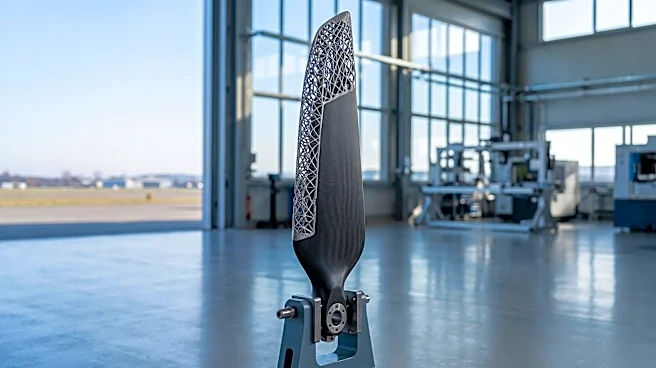
Joby Aviation has established a distributed manufacturing strategy, combining innovation hubs in California with large-scale production facilities in Ohio. Its 140-acre site at Dayton International Airport is designed to support up to two million square feet of manufacturing space and produce as many as 500 aircraft annually. Joby plans to use 3D printing for mass customization of components and on-demand spare parts to reduce logistical costs. Archer Aviation, on the other hand, relies heavily on external industrial alliances, notably with Stellantis for high-volume production and United Airlines for future flight operations. Archer's state-of-the-art production facility in Covington, Georgia, developed in partnership with Stellantis, spans 100 acres and features a 350,000 square foot factory, utilizing additive manufacturing and composite technology. Both companies are leveraging additive manufacturing to overcome weight and complexity challenges inherent in electric aviation, accelerating design cycles and enabling rapid prototyping.
Why It's Important?
The advancements by Joby Aviation and Archer Aviation are crucial for the future of urban air mobility and the broader aerospace industry in the U.S. The development of large-scale manufacturing facilities and the integration of advanced technologies like additive manufacturing signal a shift towards the commercial viability of eVTOLs. This could revolutionize urban travel by offering electric air taxi services, potentially reducing commute times and alleviating ground traffic congestion. The strategic partnerships, such as Archer's collaboration with Stellantis and United Airlines, and Joby's joint venture with Toyota Motor Corp., indicate a growing ecosystem supporting this emerging industry. These developments are not only creating new manufacturing jobs and fostering technological innovation but also positioning the U.S. at the forefront of electric aviation. The ability to mass-produce eVTOLs efficiently and cost-effectively will be critical for widespread adoption, impacting logistics, defense applications, and potentially creating new economic sectors.
What's Next?
Both Joby Aviation and Archer Aviation are on track to launch commercial operations in the near future. Joby plans to launch commercial operations by the end of 2026, with initial targets including Dubai and the United States, following its successful point-to-point eVTOL demonstration flights in New York City. Archer Aviation, having completed critical unmanned and piloted transition flights, aims to commence meaningful flight operations under the eVTOL Integration Pilot Program (eIPP) framework later in 2026. The companies will continue to focus on scaling production, refining their manufacturing processes with additive manufacturing, and securing further regulatory certifications. The integration of Wisk Aero's autonomy capabilities into Archer's manufacturing infrastructure, following Boeing's investment, suggests a future push towards autonomous eVTOL operations. The ongoing collaboration with the U.S. Air Force for military applications also indicates a dual-use strategy, expanding the market potential for these aircraft beyond commercial air taxis.
Beyond the Headlines
The widespread adoption of eVTOL technology, driven by companies like Joby and Archer, could lead to significant long-term shifts in urban planning, infrastructure development, and environmental policy. The establishment of 'vertiports' and the creation of air taxi networks will necessitate new regulatory frameworks and air traffic control systems. The emphasis on electric propulsion and lightweight materials aligns with broader sustainability goals, potentially reducing carbon emissions from transportation. However, challenges remain, including public acceptance, noise concerns, and the development of robust safety standards for autonomous flight. The integration of additive manufacturing not only streamlines production but also allows for greater customization and rapid iteration, which could lead to a more dynamic and responsive aerospace industry. This technological shift could also influence educational and workforce development, requiring new skills in advanced manufacturing, aerospace engineering, and digital design.