





What's Happening?
Canada-based Aerotex, in collaboration with Levy’s Machine Works, has successfully manufactured and certified the aviation industry’s first 3D-printed water scoop for the CL-415 amphibious firefighting aircraft. This innovation addresses the critical
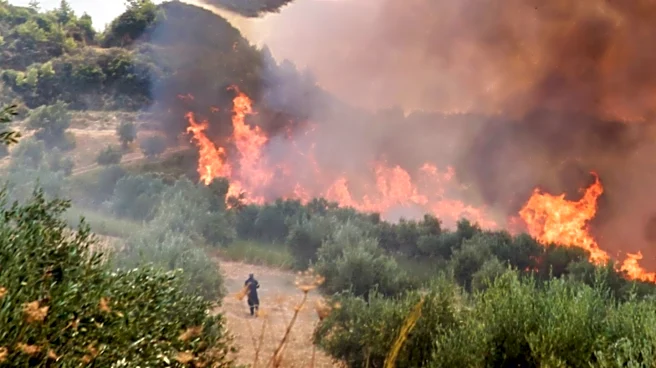
need for faster and more economical replacement parts for aerial firefighting fleets, which are under increasing demand due to intensifying wildfires globally. The CL-415 aircraft is vital for its ability to replenish water tanks in 10-12 seconds by skimming water surfaces, but its scoop systems are highly maintenance-intensive. Traditional casting methods for these specialized components result in long lead times and high manufacturing burdens. By leveraging additive manufacturing, specifically laser powder bed fusion, the companies overcame the complex geometries that were prohibitive for conventional CNC machining. This certified production process significantly reduces lead times for critical replacement hardware, moving from months to weeks, thereby enhancing the readiness of firefighting aircraft.
Why It's Important?
This development holds significant importance for U.S. aerial firefighting efforts, especially as wildfires continue to intensify across North America. The U.S. frequently battles large-scale wildfires, and the availability and readiness of water-bombing aircraft are critical for protecting communities and natural resources. By providing a faster, more cost-effective method for producing essential replacement parts, this 3D printing innovation can directly improve the operational efficiency and deployment rates of firefighting aircraft, including those used by U.S. agencies. This reduces downtime for maintenance, ensuring more aircraft are available during peak fire seasons. The success of this project also demonstrates the potential for additive manufacturing to solve supply chain challenges in other critical sectors of the U.S. aerospace and defense industries, where specialized parts often have long lead times and high costs. It sets a precedent for regulatory approval of 3D-printed components in highly regulated fields.
What's Next?
The certified production process for 3D-printed water scoops is now established, enabling high-efficiency production and significantly streamlining lead times. Aerotex and Levy's Machine Works are ready to collaborate with operators, manufacturers, and aerospace organizations to address supply chain and engineering bottlenecks. This indicates a potential expansion of this additive manufacturing solution to other components or aircraft types within the aerial firefighting sector and possibly beyond. The success in obtaining Transport Canada Civil Aviation (TCCA) approval for the additive manufacturing process itself, which became an integral part of the approved component specification, paves the way for similar regulatory certifications in other countries, including the U.S. This could lead to broader adoption of 3D printing for mission-critical aerospace parts, driven by the proven benefits of reduced lead times and enhanced fleet readiness.
Beyond the Headlines
The certification of a 3D-printed aircraft component highlights a broader shift in manufacturing paradigms, moving towards more agile and responsive production methods. This innovation challenges traditional aerospace manufacturing, which has historically relied on conventional techniques with lengthy production cycles. The ethical implications include ensuring that rapid production does not compromise safety standards, a concern addressed by the rigorous qualification framework established with Transport Canada. Legally, this sets a precedent for regulatory bodies worldwide to adapt their certification processes to accommodate additive manufacturing, potentially accelerating the integration of 3D printing into other safety-critical applications. Culturally, it signifies a growing acceptance of advanced manufacturing technologies in industries where precision and reliability are paramount, fostering a culture of innovation and adaptability in the face of evolving global challenges like climate change-driven wildfires. This could lead to a more resilient and sustainable aerospace supply chain.