




What's Happening?
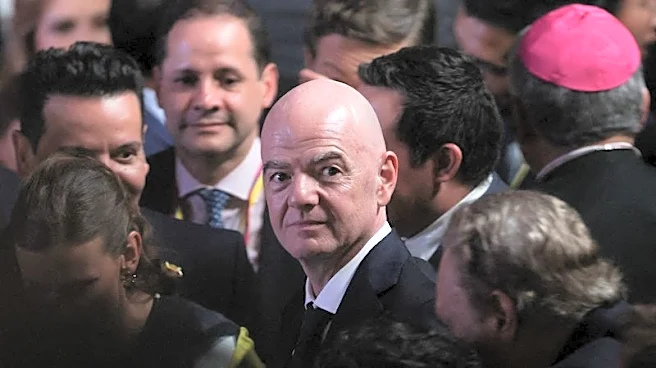
Human rights organization FairSquare has formally requested FIFA to declare its current president, Gianni Infantino, ineligible for re-election. The organization argues that Infantino has already served the maximum three terms permitted under FIFA's statutes.
While FIFA presidents are limited to three terms, Infantino successfully contended in 2022 that his initial term, which began in 2016 after Sepp Blatter's resignation and completed an interrupted mandate, should not count towards this limit. FairSquare, in a letter sent to FIFA’s Governance, Audit and Compliance Committee (GACC), asserts that this interpretation is inconsistent with FIFA's own statutes. Nicholas McGeehan, FairSquare’s Director, stated that their complaint provides clear evidence of a breach of rules, setting a dangerous precedent. Infantino is expected to seek re-election for the 2027-31 cycle at the upcoming FIFA Congress in Morocco on March 18.
Why It's Important?
This challenge to Gianni Infantino's re-election bid is significant for the governance and integrity of international sports organizations, particularly FIFA. The dispute over term limits highlights ongoing concerns about transparency and accountability within FIFA, an organization that has faced numerous corruption scandals in the past. If FairSquare's argument prevails, it could set a precedent for stricter adherence to constitutional rules and term limits across global sports federations, potentially curbing the concentration of power in leadership roles. Conversely, if Infantino is allowed to run, it could reinforce perceptions of a lack of robust oversight and the ability of powerful figures to circumvent established regulations. The outcome will influence how future leadership transitions are handled and could impact the trust placed in FIFA's governance structures by member associations, sponsors, and the public. The call for a review of Infantino's conduct by UEFA, the Asian Football Confederation, and CONCACAF, alongside concerns from national associations like the Scottish Football Association, indicates a broader discontent with current leadership practices.
What's Next?
FIFA's Governance, Audit and Compliance Committee (GACC) will need to address FairSquare's complaint regarding Gianni Infantino's eligibility for re-election. The committee's decision will be crucial, as it will either uphold the current interpretation that allows Infantino to run or rule him ineligible, potentially forcing a new leadership dynamic within FIFA. The FIFA Congress, scheduled for March 18 in Morocco, is the venue where Infantino is expected to seek re-election for the 2027-31 cycle. The reactions from major stakeholders, including UEFA, the Asian Football Confederation, CONCACAF, and various national football associations, will be closely watched. Their continued pressure or support could influence the GACC's decision and the broader political landscape within FIFA. The transparency of the GACC's reasoning, which FairSquare has criticized as lacking in the 2022 ruling, will also be a key factor in how the decision is perceived by the international community and football fans.
Beyond the Headlines
The controversy surrounding Gianni Infantino's term limits extends beyond a mere procedural dispute; it touches upon fundamental principles of good governance, checks and balances, and the prevention of entrenched power within international organizations. The argument that Infantino's initial term should not count due to it completing an 'interrupted mandate' raises questions about the spirit versus the letter of constitutional law and how such interpretations can be used to extend leadership tenures. This situation could trigger a broader re-evaluation of governance structures and term limit clauses in other global sports bodies, potentially leading to reforms aimed at enhancing democratic processes and preventing autocratic tendencies. The involvement of a human rights organization like FairSquare also underscores the growing intersection of sports governance with broader ethical and human rights considerations, suggesting that the conduct of sports leaders is increasingly being scrutinized through a wider lens of public accountability. The lack of public reasoning for the 2022 decision further highlights concerns about transparency and the potential for decisions to be made without adequate justification, eroding public trust in the institution.