






What's Happening?
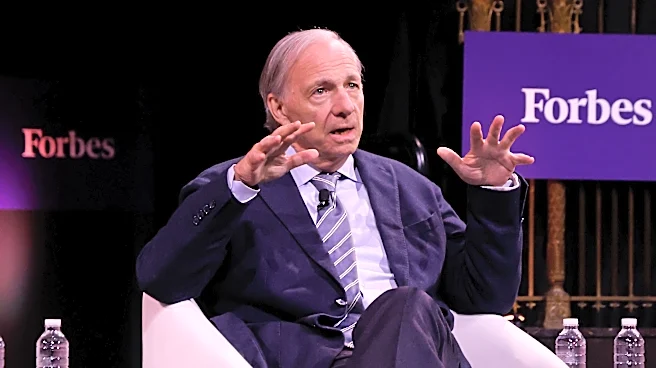
Ray Dalio, founder of Bridgewater Associates, suggests that the current AI boom is creating 'paper fortunes' that will eventually lead to a market correction. He argues that wealth, as represented by asset valuations, is distinct from money, which is required
for spending and paying taxes. Dalio believes that a bubble bursts when wealth holders are compelled to sell their assets to convert them into money, often due to factors like rising interest rates, debt obligations, or wealth taxes. He draws parallels to the 1920s, when a wave of new technologies like electricity and automobiles also led to significant paper wealth creation before a market reversal. Dalio emphasizes that the core issue is not the technology itself, but the mechanics of converting perceived wealth into spendable currency, which he views as the trigger for a market downturn.
Why It's Important?
Dalio's perspective offers a critical lens on the U.S. economy's current valuation trends, particularly in the technology sector. His framework suggests that the rapid accumulation of wealth in AI-related ventures, while seemingly positive, could be unsustainable if not backed by a corresponding ability to convert that wealth into liquid assets. This could impact investors, companies, and the broader financial system. If his prediction holds true, a significant market correction could lead to a reallocation of capital, affecting venture capitalists, tech startups, and even established corporations heavily invested in AI. The potential for a 'burst' could also influence regulatory discussions around wealth taxation and market stability, as policymakers might seek to mitigate the risks associated with such rapid wealth creation and potential subsequent contraction.
What's Next?
Dalio's analysis implies that investors should be wary of the distinction between asset valuation and liquidity. He points to potential triggers for a market reversal, such as rising interest rates or the need for wealth holders to meet financial obligations that require actual money. While he doesn't provide a specific timeline, his historical perspective suggests that such cycles are inherent to periods of rapid technological advancement and wealth creation. The implications extend to how companies manage their capital, how investors diversify their portfolios, and how financial institutions assess risk. The ongoing debate around debt limits and the composition of congressional committees, such as the Senate Banking Committee, could also play a role in shaping the financial landscape and potentially influencing the timing and severity of any market adjustments.
Beyond the Headlines
Dalio's insights delve into the fundamental nature of economic cycles and the psychological aspects of market behavior. His emphasis on the difference between wealth and money highlights a deeper economic principle: that perceived value is not always equivalent to spendable capital. This perspective challenges conventional understandings of market bubbles, suggesting they are not merely about overvaluation but about a structural imbalance in liquidity. The historical parallels he draws, from the 1920s to the 2008 financial crisis, underscore a recurring pattern in economic history where technological enthusiasm can outpace the practical mechanisms of wealth conversion. This could lead to a re-evaluation of how economic success is measured and how financial stability is maintained in an era of rapid technological change.