






What's Happening?
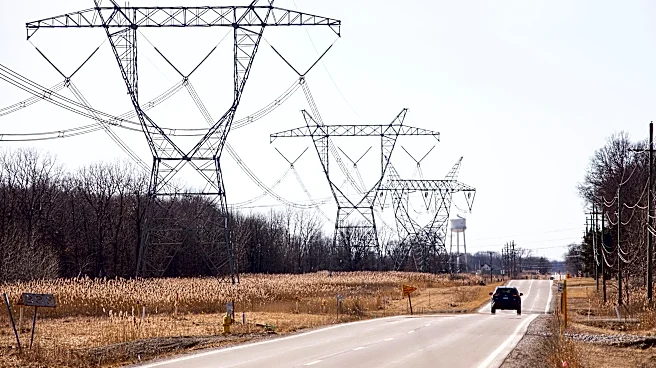
A coalition of energy companies, including Michigan-based ITC Holdings Corp., is petitioning the Federal Energy Regulatory Commission (FERC) to curtail competition in the energy transmission sector. Their request centers on suspending Order 1000, a 2011
directive that mandates a competitive bidding process for constructing transmission lines unless states opt to preempt such competition. Davis Strobridge, Director of Regulatory Strategy at ITC Holdings Corporation, stated that while Order 1000 was initially intended to foster efficiency and attract more participants to the transmission space, it has not achieved its goals. He argues that the current demand for energy significantly surpasses that of 15 years ago, and the competitive bidding process introduces substantial delays, sometimes up to two years, before construction can even commence. This delay, according to Strobridge, hinders the timely development of crucial energy infrastructure.
Why It's Important?
This push to limit competition in energy transmission carries significant implications for the U.S. energy landscape, potentially impacting consumers, utility companies, and the pace of infrastructure development. Proponents of suspending Order 1000, like ITC Holdings Corp., contend that the current competitive bidding process, while potentially leading to lower initial bids, often results in long-term cost overruns due to new bidders' unfamiliarity with project terrains. They argue that the delays inherent in the bidding process impede the rapid expansion of the energy grid, which is critical given the increased demand for energy. Conversely, the Electricity Transmission Competition Coalition (ETCC), led by Paul Cicio, advocates for maintaining Order 1000, asserting that competition drives down prices, fosters innovation, and enhances economic value. The ETCC cites studies indicating that non-competitive projects experience significant cost overruns, while competition can lead to substantial cost reductions. The outcome of FERC's decision will determine whether the U.S. prioritizes speed and potentially higher long-term costs in transmission development or continues to emphasize competitive pricing and innovation, albeit with potential delays.
What's Next?
Both Davis Strobridge of ITC Holdings Corporation and Paul Cicio, chair of the Electricity Transmission Competition Coalition, anticipate that FERC will issue its final order on this matter in the near future. However, neither could provide a specific timeline for the decision. The impending ruling from FERC will dictate the future of competitive bidding for energy transmission projects across the U.S. If FERC decides to suspend or significantly alter Order 1000, it could lead to a shift towards more vertically integrated utility companies undertaking transmission projects without competitive bidding. This could accelerate project timelines but potentially reduce cost-saving pressures. Conversely, if FERC upholds Order 1000, the competitive bidding process will remain in place, continuing to encourage diverse participation and cost-efficiency, but potentially prolonging project initiation phases. The decision will likely be met with strong reactions from various stakeholders, including energy companies, consumer advocacy groups, and environmental organizations, all of whom have vested interests in the cost, efficiency, and environmental impact of energy infrastructure.
Beyond the Headlines
The debate surrounding FERC Order 1000 extends beyond mere economic efficiency and project timelines, touching upon fundamental questions of market structure, regulatory philosophy, and the long-term resilience of the U.S. energy grid. The core tension lies between the benefits of competition—such as innovation and potentially lower initial costs—and the perceived advantages of a more streamlined, potentially less competitive approach, which proponents argue could lead to faster infrastructure deployment and better management of complex projects. This discussion highlights a broader challenge in critical infrastructure development: balancing the desire for rapid expansion and modernization with the need for cost control, accountability, and equitable access. The outcome could set a precedent for how regulatory bodies approach competition in other essential services, influencing future policy decisions regarding infrastructure investment and market design. It also underscores the ongoing struggle to adapt existing regulatory frameworks to evolving energy demands and technological advancements, particularly in the context of an aging grid and increasing pressure for energy reliability and sustainability.