



What's Happening?
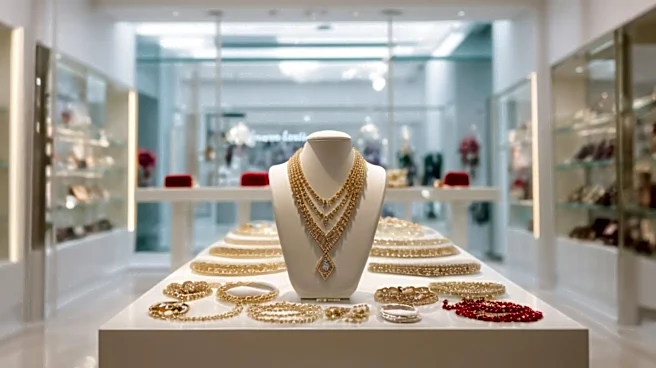
J.P. Morgan has upgraded the jewelry manufacturer Pandora from 'neutral' to 'overweight,' indicating a more positive outlook for the company's stock. This decision is primarily driven by signs of improving brand momentum for Pandora and a significant
fall in silver prices, which are now below $40 an ounce after a more than 45% drop in six months. This reduction in silver prices allows Pandora to adjust its metal mix, potentially improving profit margins. The broker forecasts a fourth-quarter like-for-like sales growth of 4.5% for Pandora, surpassing the consensus estimate of 2.7%. Consequently, J.P. Morgan has also raised its price target for Pandora to DKK1,175 from DKK890. This upgrade comes as J.P. Morgan anticipates a stagnation in European luxury goods sales by 2027, with a drag from Chinese consumers offsetting positive contributions from U.S. shoppers.
Why It's Important?
This upgrade by J.P. Morgan signals a potential shift in investor sentiment towards Pandora, highlighting the company's resilience and strategic advantages within the luxury goods market. The improving brand momentum suggests that Pandora's marketing and product strategies are resonating with consumers, potentially leading to increased sales and market share. The decline in silver prices is a crucial factor, as it directly impacts Pandora's cost of goods sold. Lower raw material costs can lead to higher profit margins, which is a significant positive for the company's financial performance. For U.S. investors, this could mean a more attractive investment opportunity in a company that is demonstrating strong operational improvements despite broader market challenges in the luxury sector. The forecast of strong fourth-quarter sales growth further reinforces the positive outlook, suggesting that Pandora is well-positioned to outperform its peers.
What's Next?
Following J.P. Morgan's upgrade, Pandora's stock performance will likely be closely monitored by investors. The company's upcoming full-year results, expected in late January, will provide further insights into its financial health and the impact of the improving brand momentum and lower silver prices. Investors will be looking for confirmation of the forecasted 4.5% like-for-like sales growth for the fourth quarter. The ability of Pandora to effectively adjust its metal mix in response to falling silver prices will be key to realizing the anticipated margin improvements. Additionally, the broader luxury goods market will be under scrutiny, particularly how the anticipated stagnation in European sales by 2027, influenced by Chinese consumer behavior, will affect companies like Pandora that have a global presence. The company's strategies to leverage positive contributions from U.S. shoppers will also be critical.
Beyond the Headlines
The J.P. Morgan upgrade of Pandora underscores a broader trend within the luxury market where companies with strong brand identity and adaptable supply chains can thrive even amidst economic uncertainties. The significant drop in silver prices highlights the impact of commodity market fluctuations on consumer goods industries and the importance of strategic sourcing and metal mix adjustments for profitability. This situation also brings to light the evolving dynamics of global consumer spending, particularly the contrasting influences of Chinese and U.S. consumers on the luxury sector. Pandora's ability to maintain brand momentum and capitalize on favorable raw material costs could serve as a case study for other luxury brands navigating a complex global economic landscape, emphasizing the need for agility and a deep understanding of market trends.