
What's Happening?
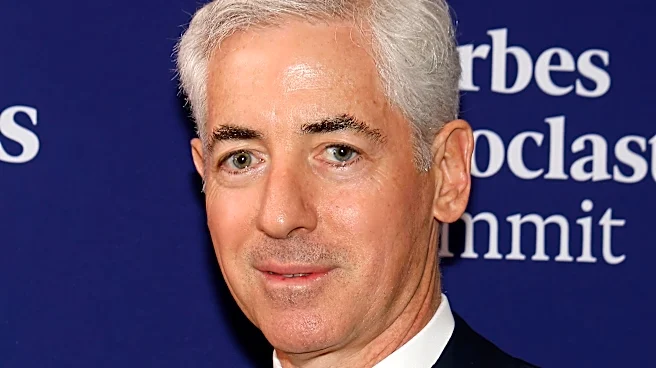
Hedge fund manager Bill Ackman's net worth has reportedly increased significantly, with Bloomberg estimating it at over $10.5 billion and Forbes at $9.6 billion. This surge in wealth for Ackman, who is 30
years younger than his long-time rival Carl Icahn, coincides with a substantial decline in Icahn's fortune. Icahn's net worth has dropped to $1.3 billion, a significant decrease from its peak of over $20 billion a few years ago, leading to his exit from the list of the world's 400 richest individuals. Icahn Enterprises (IEP), the hedge fund built by Carl Icahn, is facing considerable financial difficulties, including existential risks. The company's stock has fallen to a record low, and it is grappling with a $1.4 billion debt due in May, with management unable to guarantee refinancing on favorable terms. Despite a high dividend yield of 72%, there is concern that the payout may be cut to preserve cash, further impacting equity.
Why It's Important?
The diverging financial fortunes of Bill Ackman and Carl Icahn highlight significant shifts in the landscape of activist investing and hedge fund management. Ackman's growing wealth, derived from Pershing Square Capital's substantial assets under management and its fee-based model, suggests a more resilient and sustainable growth trajectory. Conversely, Icahn Enterprises' struggles, marked by a plummeting stock price and significant debt, underscore the inherent risks and potential vulnerabilities within highly leveraged investment vehicles, especially for companies facing refinancing challenges. The situation with IEP could serve as a cautionary tale for investors drawn to high dividend yields without thoroughly assessing underlying financial stability and debt obligations. The potential failure to refinance IEP's debt could have broader implications for the high-yield bond market and investor confidence in similar distressed assets.
What's Next?
For Icahn Enterprises, the immediate future hinges on its ability to refinance the $1.4 billion in bonds due in May. The company is actively working to improve its business and raise necessary cash, including recent asset sales like Pep Boys, which generated $645 million in net proceeds. However, it remains uncertain if these measures will be sufficient to address the debt in the near term, especially given ongoing quarterly losses. Investors will closely monitor any announcements regarding debt refinancing and potential dividend policy changes, as a cut in payouts could further depress the stock. For Bill Ackman, his focus is likely to remain on growing Pershing Square Capital and developing Howard Hughes Corporation as a primary vehicle for his empire, aiming for a model similar to Berkshire Hathaway. His continued success could solidify his position as a leading figure in the investment world.
Beyond the Headlines
The contrasting trajectories of Ackman and Icahn also reflect a generational shift in the investment world. At 90, Carl Icahn faces challenges related to time and energy in turning around his company, while the 60-year-old Ackman has a longer runway for growth and strategic development. This situation brings to light the importance of succession planning and long-term sustainability in investment firms, particularly those heavily reliant on the vision and leadership of a single individual. The 'value trap' scenario observed with Icahn Enterprises, where a high dividend yield masks underlying financial distress, also raises ethical considerations for investment advice and the responsibility of management to transparently communicate risks to shareholders. The ongoing rivalry, highlighted by Ackman's public sharing of news regarding Icahn's declining wealth, underscores the personal and competitive dynamics that often play out in the high-stakes world of finance.