






What's Happening?
A documentary review discusses 'SCTV: The Greatest Show You’ve Never Heard Of,' which explores the Canadian sketch comedy series 'SCTV' and its legacy as a significant rival to 'Saturday Night Live' (SNL). The review notes that while 'SCTV' aired years
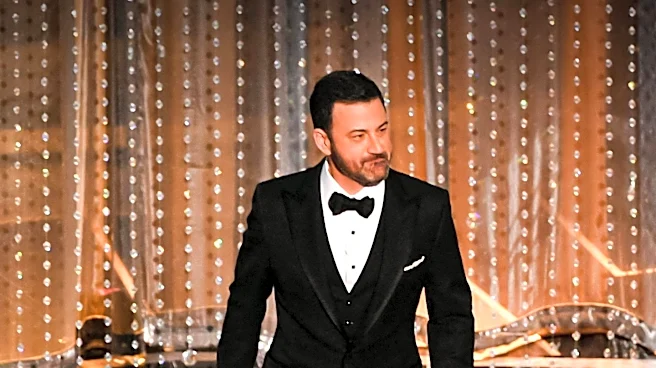
after the original SNL cast, its ensemble, including Catherine O’Hara, Eugene Levy, Rick Moranis, Martin Short, and John Candy, were contemporaries of SNL's early performers. The documentary, directed by Jason Hehir and produced by Jimmy Kimmel, features insights from former SNL writers Bob Odenkirk and Conan O’Brien, who praise 'SCTV' for its conceptual comedy and the cast's impressionistic talents. Unlike SNL, 'SCTV' was not 'live' in the same sense, lacking the 'working without a net' energy, but this allowed for more 'out there' bits to make it to air without last-minute cuts. The review also touches on the cast's initial struggles for recognition and their eventual triumph at the 1982 Emmys.
Why It's Important?
This documentary review is important because it sheds light on 'SCTV,' a critically acclaimed but perhaps less widely known sketch comedy show that significantly influenced the landscape of television comedy. By positioning 'SCTV' as a 'most serious rival' to 'Saturday Night Live,' the review highlights the diverse approaches to sketch comedy that existed during that era. It underscores the creative freedom and unique comedic style that 'SCTV' cultivated, contrasting it with SNL's live format. For comedy enthusiasts and television historians, the documentary offers valuable insights into the creative processes, challenges, and enduring impact of a show that fostered many legendary comedians. It also provides context for how different comedic sensibilities can thrive and contribute to the broader entertainment industry, even if one show achieves more mainstream recognition than another.
What's Next?
The documentary 'SCTV: The Greatest Show You’ve Never Heard Of' aims to bring renewed attention to the series and its cast, potentially introducing it to new generations of viewers. With old episodes archived on Netflix, the documentary could drive increased viewership and appreciation for 'SCTV's' unique brand of humor. For the surviving cast members and creators, this renewed interest could lead to further recognition and retrospectives. The discussion of 'SCTV' in comparison to 'Saturday Night Live' also contributes to ongoing conversations about the evolution of sketch comedy and the different creative environments that foster comedic talent. This could inspire future analyses or documentaries exploring other influential but perhaps overlooked comedy programs.
Beyond the Headlines
The comparison between 'SCTV' and 'Saturday Night Live' in the documentary review delves into deeper aspects of comedic creation and audience reception. 'SCTV's' conceptual comedy, which often revolved around the fictional TV station of Mellonville, allowed for a unique meta-narrative that distinguished it from SNL's more direct sketch format. The review notes that 'SCTV' was 'smart, edgy and sometimes mean,' suggesting a different comedic tone that resonated with a specific audience. This highlights the idea that there isn't a single formula for successful comedy, and that diverse approaches can yield equally impactful, albeit different, results. The documentary also implicitly explores the challenges of creative control versus network demands, as exemplified by Eugene Levy's refusal to make 'SCTV' more 'family friendly' for NBC. This underscores the artistic integrity that can drive comedic creators, even when faced with commercial pressures, and how such decisions shape the legacy of a show.