






What's Happening?
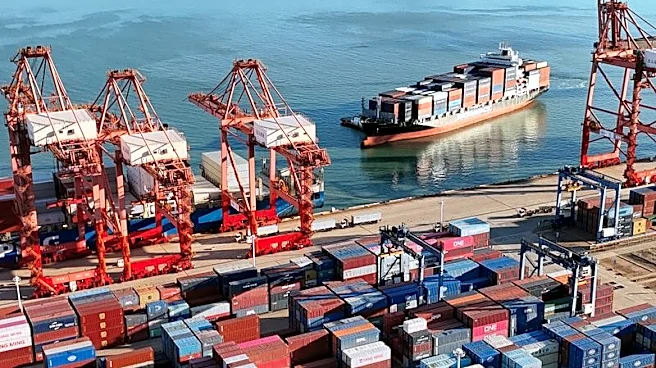
Research from the Federal Reserve indicates that U.S. tariffs imposed on Chinese products have led to persistent declines in import prices for those same Chinese goods in 'bystander' countries. While U.S. imports from China have decreased, Chinese exports
have continued to expand globally. The study found that these price declines are most significant in emerging markets and are more pronounced for products that China heavily exported to the U.S. prior to the tariffs. The price adjustments are also larger in concentrated import markets and in countries with closer geopolitical ties to China. This phenomenon is notable because, in the U.S., the country that imposed the tariffs, there has been a lack of price adjustment for Chinese imports.
Why It's Important?
This finding reveals a significant spillover effect of U.S. tariff policy, demonstrating how trade actions can reshape global pricing dynamics beyond the directly targeted countries. For U.S. consumers and businesses, the lack of price adjustment for Chinese imports in the U.S. suggests that the costs of tariffs are largely borne domestically, rather than by Chinese exporters. Meanwhile, consumers and firms in bystander countries, particularly emerging markets, may benefit from lower prices on Chinese goods. This creates a complex global trade environment where U.S. policy indirectly influences the competitiveness and affordability of goods in other nations, potentially altering trade flows and economic relationships worldwide. It highlights the intricate and often unintended consequences of protectionist measures.
What's Next?
The observed trade deflection and price declines in bystander countries suggest that U.S. tariff policies are not solely impacting the U.S. and China. Future analyses of U.S. trade policy will need to consider these broader global effects, including how they influence international supply chains and the economic stability of emerging markets. Policymakers may need to evaluate whether the benefits of tariffs in achieving their stated objectives outweigh these complex international spillover effects. The continued expansion of Chinese exports globally, despite U.S. tariffs, indicates a strategic adaptation by China to find new markets, further complicating the effectiveness of targeted trade restrictions.
Beyond the Headlines
The phenomenon of trade deflection and price adjustments in bystander countries raises deeper questions about the efficacy and equity of unilateral tariff actions. It suggests that while tariffs may reduce imports from a targeted country, they can also lead to a redistribution of trade and economic benefits globally, potentially at the expense of the tariff-imposing nation's consumers. This dynamic could incentivize other countries to deepen trade relationships with the targeted nation, undermining the intended pressure of the tariffs. The study also implicitly highlights the interconnectedness of the global economy, where actions by one major player can have far-reaching and sometimes counterintuitive consequences for others, necessitating a more holistic understanding of trade policy impacts.