





What's Happening?
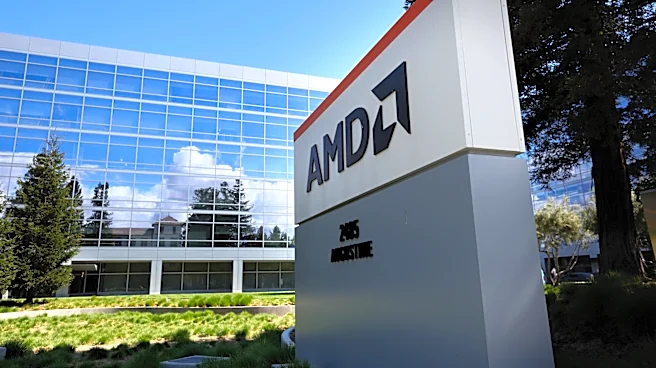
Semiconductor giant AMD has completed its acquisition of World Labs, a world model developer, for $8.2 billion in an all-stock deal. World Labs, founded in April 2024 by Stanford University professor Fei-Fei Li, her former PhD student Justin Johnson,
and Ben Mildenhall, specializes in spatial intelligence and 3D content generation. Following the acquisition, Fei-Fei Li will assume the role of Executive Vice President and Chief Scientist at AMD, reporting directly to Chair and CEO Lisa Su. The acquisition process, from signing to closing, took only 46 days. World Labs, with approximately 70 employees, launched its first commercial product, Marble, in November 2025, which generates editable 3D scenes from text or images. In September 2026, it released Atlas, a multimodal world model unifying text, images, videos, and 3D content. The company also acquired SceniX, a robot simulation company, to integrate robot bodies and sensors into virtual environments for training.
Why It's Important?
This acquisition is significant for AMD as it aims to integrate advanced AI model development directly into its hardware design process. By bringing Fei-Fei Li and the World Labs team into its core management, AMD seeks to address the computing bottlenecks of next-generation AI, particularly in spatial intelligence, at an earlier stage of hardware roadmap finalization. This move allows AMD to better understand the demands of evolving AI models, such as those for generating 3D scenes and simulating object collisions, and to tailor its chips, software, and systems accordingly. For Fei-Fei Li, this partnership provides the dedicated hardware investment necessary to scale AI efficiency and expand its scope beyond the digital realm into the physical world. The integration of World Labs' expertise in foundational models and spatial intelligence is expected to enhance AMD's competitive position in the rapidly evolving AI and semiconductor industries.
What's Next?
Following the acquisition, Fei-Fei Li will lead the integration of World Labs' research into AMD's computing ecosystem. The World Labs team will continue its R&D on foundational models as an independent cutting-edge research organization, collaborating closely with AMD's hardware, software, and system engineers. A key focus will be connecting models, simulation tools, chips, and robotic systems to advance physical AI and robotics. AMD will need to demonstrate the value of this integrated solution to developers to compete with established players like NVIDIA in spatial AI and physical simulation. The challenge will also involve addressing the significant data requirements for training robots in virtual environments and ensuring the physical credibility of these simulations to bridge the gap between virtual training and real-world application. The long-term goal is to ensure that AI technology, as it moves into the physical world, is reliable, controllable, and ultimately beneficial to people.
Beyond the Headlines
The acquisition of World Labs by AMD highlights a broader trend in the AI industry: the increasing convergence of hardware and software development, particularly as AI expands from digital applications to interacting with the physical world. Fei-Fei Li's career, marked by her pioneering work on ImageNet and her emphasis on human-centered AI, underscores the ethical and societal implications of this technological shift. As AI systems gain spatial intelligence and the ability to act in 3D environments, questions of safety, reliability, and accountability become paramount. The move into robot simulation and physical AI raises complex challenges related to data collection, the accuracy of virtual environments, and the transferability of learned behaviors to real-world robots. This development also reflects the growing importance of interdisciplinary collaboration, bringing together experts in AI models, chip design, and robotics to address the multifaceted challenges of advanced AI. The success of this integration will not only impact AMD's market position but also influence the trajectory of AI's practical applications and its societal impact.