





What's Happening?
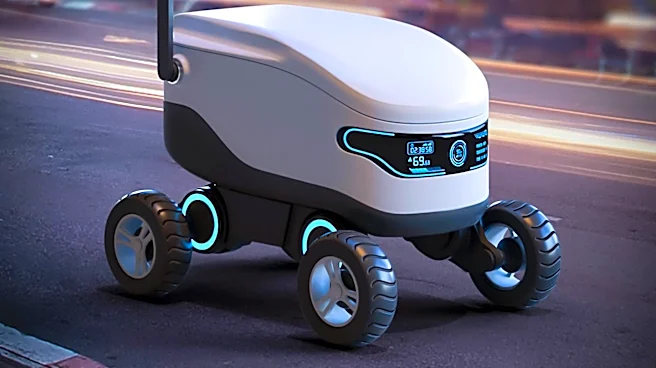
Avride Inc. has advanced its delivery robot technology by integrating cloud-based vision-language models (VLMs) to enhance the robots' ability to navigate complex urban environments. These robots, which operate autonomously on city streets, are equipped
with onboard sensors and neural networks to detect various elements such as pedestrians and traffic lights. However, to address the challenge of understanding complex real-world scenarios, Avride has implemented VLMs as a 'VLM-watcher' to provide a deeper contextual understanding. This system allows the robots to identify unusual or sensitive situations, such as active crime scenes or emergency areas, which basic object detection might miss. The VLMs process visual data in the cloud, translating it into semantic descriptions and alerting human operators if critical situations are detected, ensuring the robots behave appropriately in high-stakes environments.
Why It's Important?
The integration of VLMs into Avride's delivery robots represents a significant advancement in autonomous technology, particularly in enhancing safety and operational efficiency. By providing a deeper understanding of complex environments, these models help prevent robots from inadvertently entering sensitive areas, thereby reducing the risk of accidents or disruptions. This development is crucial for the broader adoption of autonomous delivery systems in urban settings, where the ability to navigate safely and efficiently is paramount. The use of cloud-based models also highlights the potential for AI to augment human oversight, ensuring that robots can operate independently while still being monitored for safety. This approach could set a precedent for other companies in the autonomous vehicle industry, emphasizing the importance of combining AI with human intervention to achieve optimal results.
What's Next?
Avride plans to continue refining its technology by eventually migrating the VLMs from the cloud to the robots' onboard systems. This transition would allow for even greater autonomy, as the robots would be able to process complex scenarios without relying on network connectivity. As VLMs become more compact and onboard hardware improves, Avride aims to enhance the robots' decision-making capabilities, making them more independent and efficient. In the meantime, the current cloud-based system will continue to serve as a safety net, ensuring that the robots remain aware and responsive to their surroundings. This ongoing development could lead to broader applications of autonomous technology in various industries, potentially transforming how goods are delivered in urban environments.