




What's Happening?
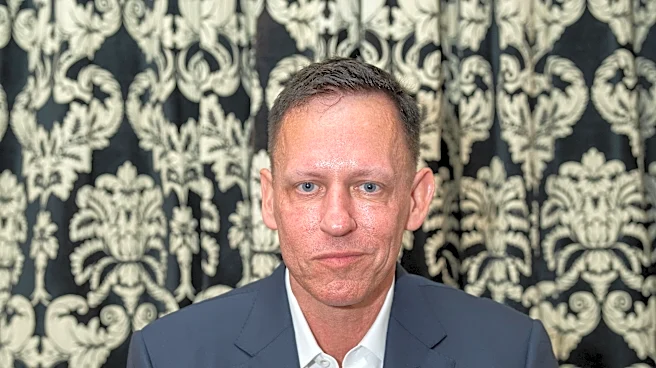
Jack Selby, Managing Director at Thiel Capital and a longtime business partner of Peter Thiel, has issued a strong warning about an existing AI bubble, predicting a significant market correction. Selby, who has worked with Thiel for 27 years and was one
of PayPal's first 10 employees, stated on the 'How I Invest' podcast that factors such as high valuations, inflated multiples, and circular financing are clear indicators of a bubble. He emphasized that a correction is a matter of 'when, not if,' and that hundreds of billions of dollars invested in the sector could turn to zero. Selby compared the current AI boom to the dot-com internet boom, noting that the AI market is capital-expenditure intensive and relies heavily on storytelling to attract investment.
Why It's Important?
Selby's warning carries significant weight due to his extensive experience in technology and investment, particularly his close association with Peter Thiel, a prominent investor in AI companies like OpenAI and Palantir Technologies. His comments highlight growing concerns among seasoned investors about the sustainability of current AI valuations. A market correction in the AI sector could have widespread repercussions across the U.S. economy, impacting venture capital firms, technology companies, and institutional investors. It could lead to a re-evaluation of investment strategies, a tightening of funding for AI startups, and potentially a more cautious approach to AI adoption by businesses. The comparison to the dot-com bubble serves as a stark reminder of the potential for rapid value destruction when market exuberance outpaces fundamental economic realities.
What's Next?
In the immediate future, Selby's remarks could contribute to increased investor caution and scrutiny within the AI sector. Companies with high valuations, particularly those relying on speculative growth rather than proven profitability, may face greater pressure to demonstrate tangible returns. This could lead to a more discerning investment environment, where capital flows towards AI companies with robust business models and clear paths to profitability, rather than those primarily driven by 'storytelling.' The potential correction might also prompt a shift in focus from building 'trillion-dollar companies' to fostering sustainable growth for smaller, more specialized AI firms. Stakeholders, including startups, investors, and policymakers, will be closely watching for signs of market stabilization or further indications of an impending downturn.
Beyond the Headlines
Selby's critique extends beyond mere financial metrics, touching upon the broader cultural and psychological aspects of the current AI boom. His observation that too much pressure is placed on building 'trillion-dollar AI companies' suggests a misalignment between market expectations and realistic business development. This 'trader's market' mentality, as he describes it, prioritizes short-term gains and speculative investments over long-term value creation. The reliance on 'storytelling' to raise money, rather than concrete fundamentals, points to a potential ethical hazard where narratives can overshadow substance. This situation could lead to a period of introspection within the tech industry, encouraging a return to more fundamental principles of business building and a greater emphasis on sustainable innovation rather than speculative bubbles.