


What's Happening?
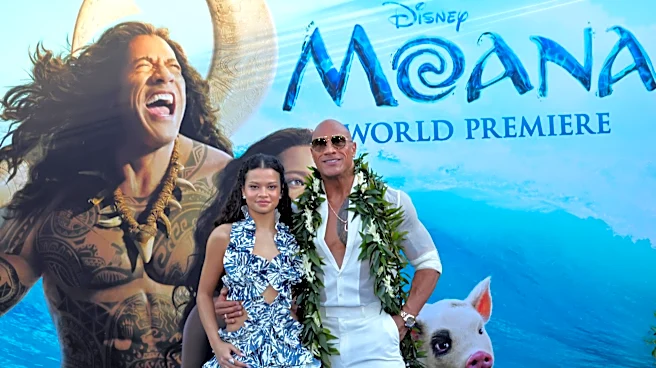
Disney's 'Moana' franchise has experienced a complex trajectory, marked by the unexpected box office success of its animated sequel, 'Moana 2,' and the subsequent failure of its live-action remake. 'Moana 2,' originally conceived as a Disney+ series,
was retrofitted into a theatrical release by Bob Iger and grossed $225.4 million over its five-day Thanksgiving weekend. This performance nearly matched the original 'Moana's' entire domestic haul of $248.8 million. Despite the animated sequel's success, Disney proceeded with a live-action remake, which reportedly flopped significantly. The original 'Moana,' released in 2016, is considered a major accomplishment for Disney, launching Auli'i Cravalho's career and featuring Dwayne Johnson's acclaimed performance and Lin-Manuel Miranda's songs. The decision to develop a live-action remake while the animated franchise was still active, particularly after the success of 'Moana 2,' has been noted as a deviation from Disney's usual strategy of only remaking inactive animated franchises.
Why It's Important?
The contrasting fortunes of 'Moana 2' and the live-action remake highlight Disney's evolving strategy for its animated properties and the audience's preferences. The strong box office performance of 'Moana 2' demonstrates a clear demand for animated sequels within established franchises, even when initial production was not geared for theatrical release. This suggests that audiences prioritize continuation of beloved animated stories over new live-action interpretations, especially when the original animated film is relatively recent. The failure of the live-action remake, despite Dwayne Johnson's involvement, indicates potential audience fatigue with the live-action remake trend, particularly when it feels like a 'cash grab' or lacks creative originality. This could influence Disney's future decisions regarding which animated films to adapt into live-action and when, potentially leading to a more cautious approach to remakes of currently active franchises. It also underscores the financial power of animated content when it resonates with audiences.
What's Next?
Following the live-action remake's failure, there is speculation that Disney will now focus on further animated sequels for the 'Moana' franchise. The success of 'Moana 2' has created an expectation for 'Moana 3,' with fans anticipating a proper continuation of the animated story. It is expected that if a third animated film is greenlit, it would feature Lin-Manuel Miranda returning to write songs, ensuring continuity with the beloved musical elements of the original. The studio's previous reluctance to announce 'Moana 3' while the live-action remake was still on the calendar suggests that the path is now clear for animated development. An announcement regarding a new animated sequel could be made within the next year, signaling Disney's renewed commitment to the animated future of the 'Moana' universe.
Beyond the Headlines
The 'Moana' franchise's recent developments reflect broader industry trends and challenges for major studios like Disney. The rapid production of a live-action remake, less than seven years after the original animated film, points to a strategy driven by intellectual property monetization rather than purely creative impetus. This approach risks diluting the brand and alienating audiences who perceive such remakes as unnecessary. The success of 'Moana 2,' despite its origins as a streaming series, also highlights the fluidity between streaming and theatrical distribution, and how audience reception can dictate a project's ultimate platform. This situation could prompt Disney to re-evaluate its content pipeline, potentially prioritizing audience demand for authentic storytelling over a rigid adherence to live-action remake schedules. It also raises questions about the long-term sustainability of relying heavily on remakes versus investing in original animated content or direct animated sequels.