








What's Happening?
John Law, a co-founder of the Burning Man festival, has publicly expressed his disappointment with the event's current state, stating it has lost its 'anarchist soul' and become a commercialized spectacle for the affluent. In an essay for the San Francisco
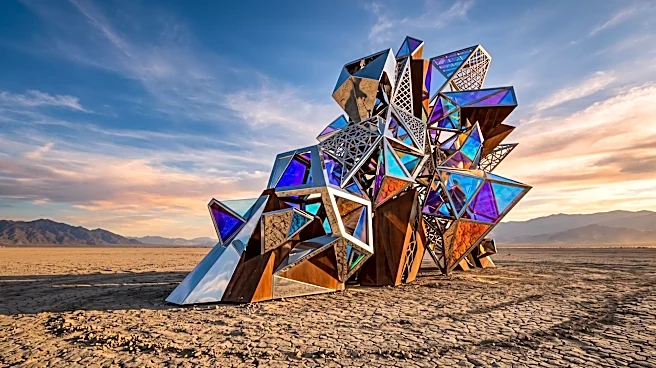
Standard, Law, who was instrumental in moving the festival to Nevada's Black Rock Desert in 1990, described the event as 'barely recognizable' from its original vision. He characterized the modern Burning Man as a 'massive, kaleidoscopic extravaganza' and a 'fabulous Disneyland for the well-heeled,' consumed by Western elites and middle-class creatives. Law noted that attendees now often arrive in business jets and stay in luxury camps with private chefs, transforming the festival into a 'commercialized escape hatch.' The HBO docuseries 'The Man Will Burn' further explores these changes, highlighting the festival's evolution and the ongoing debates surrounding its identity.
Why It's Important?
This critique from a co-founder highlights a significant cultural and philosophical shift within one of America's most iconic counter-cultural events. The transformation of Burning Man from an 'anarchistic collaboration of equals' to a perceived playground for the wealthy elite reflects broader societal trends of commercialization and exclusivity impacting once-inclusive movements. This shift raises questions about the accessibility and original intent of large-scale community-driven events. The increasing ticket prices, ranging from $550 to $3,000, further underscore the financial barrier to entry, potentially alienating participants who cannot afford the rising costs. The festival's evolution also sparks debate about the role of wealth and corporate influence in shaping cultural phenomena, as evidenced by Silicon Valley companies like Google busing employees to the event. This commercialization can dilute the core principles of radical self-reliance and communal effort that initially defined Burning Man, impacting its long-term cultural legacy.
What's Next?
The criticisms from co-founder John Law, coupled with the HBO docuseries 'The Man Will Burn,' are likely to intensify ongoing discussions about Burning Man's future direction and its adherence to its founding principles. The Burning Man Project, the organization overseeing the event, may face increased pressure to address concerns regarding commercialization, accessibility, and the perceived shift towards catering to a wealthier demographic. This could lead to internal re-evaluations of ticketing structures, participant demographics, and the overall ethos of the festival. Stakeholders, including long-time 'Burners' and new attendees, will likely continue to debate the balance between growth, financial sustainability, and maintaining the event's original 'anarchist soul.' The festival's organizers may need to consider strategies to foster greater inclusivity and reinforce its core values to counter the narrative of it becoming a 'Fyre Fest 2.0' for the rich.
Beyond the Headlines
The evolution of Burning Man, as described by John Law, reflects a deeper societal tension between counter-cultural ideals and the pervasive influence of capitalism and wealth. What began as an experiment in temporary community, art, and self-expression, free from commercial pressures, has seemingly succumbed to the very forces it sought to transcend. This raises ethical questions about the sustainability of anti-establishment movements when faced with mainstream popularity and financial opportunities. The festival's journey from a small gathering to a global phenomenon, attracting Silicon Valley elites, illustrates how even radical concepts can be co-opted and transformed. This phenomenon is not unique to Burning Man, mirroring similar trajectories in other cultural movements and artistic endeavors. The debate over Burning Man's 'soul' highlights the ongoing challenge of preserving authenticity and core values in the face of growth and commercial success, prompting reflection on what truly constitutes a 'community' versus a 'consumer experience' in contemporary society.