



What's Happening?
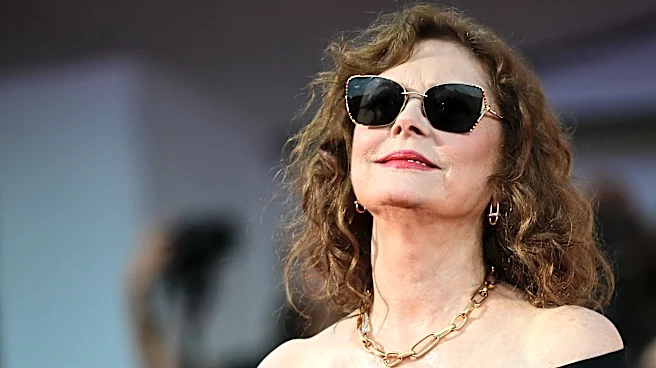
Oscar-winning actress Susan Sarandon has stated that she continues to lose acting roles due to her pro-Palestinian views. While promoting her new film, 'The Echo Chamber,' at the Venice Film Festival, Sarandon claimed that agencies are still advising
against hiring her. She noted a shift in public opinion regarding U.S. support for Israel, suggesting that more people are now aware of the historical context of Palestine and the financial ties between the U.S. and Israel. Sarandon was previously dropped by her talent agency, UTA, in 2023, following comments she made at pro-Palestine rallies after the October 7, 2023, Hamas attack. Despite her personal challenges, she feels welcomed internationally. The Venice Film Festival itself faced scrutiny from activists who called for the Palestinian flag to be raised, a request denied by artistic director Alberto Barbera due to Italy's non-recognition of the state of Palestine.
Why It's Important?
This situation highlights the significant impact of political activism on careers within the U.S. entertainment industry, particularly concerning the Israeli-Palestinian conflict. Sarandon's experience underscores the potential professional repercussions for public figures who take strong stances on contentious international issues. It also reflects a broader societal tension in the U.S. regarding freedom of speech versus perceived political correctness or industry pressures. The alleged blacklisting of an actress of Sarandon's stature could deter other artists from expressing their political views, potentially chilling free expression within Hollywood. Furthermore, her comments about changing public opinion on U.S. aid to Israel suggest a growing public debate that could influence future foreign policy discussions and public discourse in the United States.
What's Next?
The ongoing debate surrounding Susan Sarandon's career and her pro-Palestinian activism is likely to continue to fuel discussions about political expression in Hollywood and the broader U.S. media landscape. Other public figures may face similar pressures, leading to increased scrutiny of their political affiliations and statements. This could prompt further calls for transparency from talent agencies and production companies regarding their hiring practices and political stances. The issue may also contribute to a wider conversation about the role of celebrities in political advocacy and the boundaries of free speech in professional contexts. As public opinion on the Israeli-Palestinian conflict continues to evolve, the entertainment industry may find itself increasingly navigating these complex political waters, potentially leading to shifts in how artists are supported or sanctioned for their views.
Beyond the Headlines
Beyond the immediate professional consequences for Susan Sarandon, this situation touches upon deeper issues of ideological conformity and the power dynamics within influential industries. It raises questions about whether certain political viewpoints are implicitly or explicitly penalized, potentially leading to a self-censorship culture among artists. The incident also highlights the intersection of international politics with domestic cultural industries, demonstrating how global conflicts can have tangible effects on individual careers and artistic freedom in the U.S. It prompts a critical examination of the mechanisms through which public figures are held accountable for their political statements, and whether these mechanisms are applied equitably across the political spectrum. Ultimately, it contributes to the ongoing discourse about the responsibilities of public figures and the ethical considerations of industries in a politically charged environment.