






What's Happening?
Optics Trainer has published an article detailing the methods and norms for measuring accommodative amplitude and facility, which are crucial for assessing eye focusing. The article explains three common subjective methods: push-up, push-down, and minus
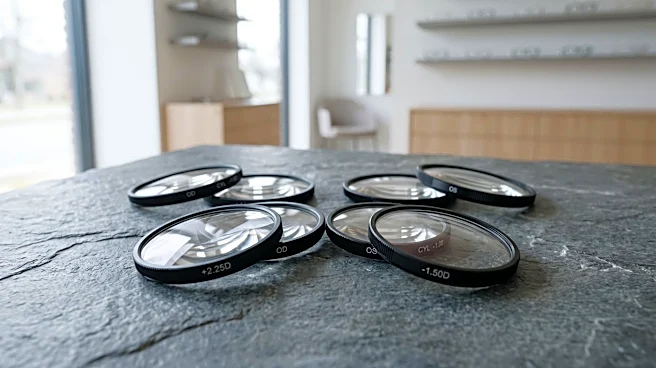
lens. The push-up method involves moving a near target towards the eye until sustained blur is reported, while the push-down method starts with the target inside the near point and moves it away until it clears. The minus lens method keeps the target at a fixed near distance and adds minus power until the patient can no longer clear it. The article highlights that these methods are not interchangeable, with mean differences often exceeding 1.75 D among young adults. Hofstetter's formulas, which predict minimum, average, and maximum expected amplitude based on age, are also discussed, though their limitations regarding population applicability are noted. Accommodative insufficiency is commonly defined as a push-up amplitude at least 2 D below the minimum expected value.
Why It's Important?
Accurate measurement of accommodative amplitude and facility is vital for diagnosing and managing various vision conditions, particularly accommodative insufficiency and excess. The discrepancies between different testing methods, as highlighted by Optics Trainer, underscore the importance for eye care professionals to consistently use one method and compare results with matching norms. This consistency ensures reliable diagnoses and effective treatment plans. For patients, understanding these measurements can lead to better management of eye focusing issues, which can impact daily activities, learning, and overall quality of life. The discussion of Hofstetter's formulas and their limitations also emphasizes the need for population-specific norms, suggesting that a one-size-fits-all approach may not be sufficient for diverse patient demographics in the U.S. and globally. This impacts research and clinical practice in optometry and ophthalmology.
What's Next?
The ongoing discussion about the reliability and applicability of different accommodative amplitude testing methods suggests a continued need for research into standardized protocols and population-specific norms. Eye care professionals are encouraged to be aware of the limitations of current methods and to select a consistent approach for diagnosis and follow-up. Future developments may include the refinement of existing formulas or the development of new diagnostic tools that offer greater accuracy and interchangeability across methods and populations. The article also implicitly calls for further studies, similar to the Convergence Insufficiency Treatment Trial (CITT), to evaluate the effectiveness of various therapies for accommodative dysfunction, ensuring that treatment strategies are evidence-based and tailored to individual patient needs.
Beyond the Headlines
The detailed analysis of accommodative amplitude and facility extends beyond routine eye exams, touching upon broader implications for public health and educational outcomes. Undiagnosed or poorly managed accommodative dysfunctions can contribute to visual fatigue, headaches, and difficulties with reading and close-up tasks, potentially affecting academic performance in children and productivity in adults. The variability in test results and the limitations of age-based formulas also raise questions about equitable access to accurate diagnoses for diverse populations. This highlights a need for culturally sensitive and geographically relevant research to ensure that diagnostic criteria and treatment guidelines are universally applicable and effective, ultimately improving vision care standards and patient outcomes across the U.S. and beyond.