






What's Happening?
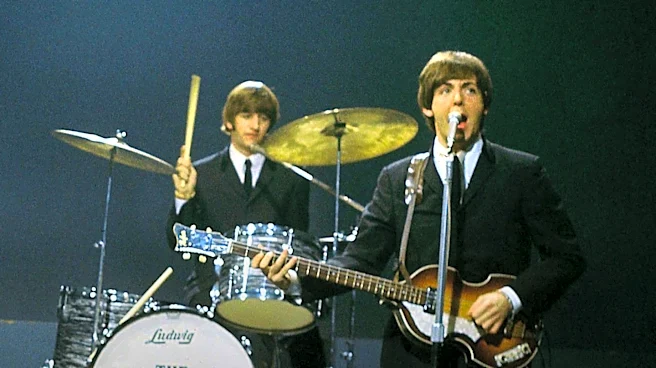
In a 1999 interview, Paul McCartney recounted the pivotal moment he met John Lennon on July 6, 1957, at a church fete in Liverpool. Lennon, then 16, and McCartney, 15, connected through a mutual friend, Ivan Vaughan. During a break in The Quarrymen's
performance, McCartney was asked to play guitar. Despite being left-handed and having to play a right-handed guitar upside down, McCartney impressed Lennon. The crucial factor in McCartney being invited to join Lennon's skiffle group was his knowledge of the lyrics to Eddie Cochran's song, 'Twenty Flight Rock.' This song was featured in the 1956 U.S. musical comedy 'The Girl Can't Help It,' a film that significantly influenced Liverpool teens and introduced American rock and roll to British audiences. McCartney had learned the lyrics by repeatedly watching Cochran's performance in the film, as the record was not readily available in the U.K. at the time.
Why It's Important?
This historical account highlights a foundational moment in music history, directly leading to the formation of The Beatles, one of the most influential bands globally. McCartney's ability to perform 'Twenty Flight Rock' not only secured his place in The Quarrymen but also demonstrated the significant cultural impact of American rock and roll on British youth in the 1950s. The film 'The Girl Can't Help It' served as a crucial conduit for this cultural exchange, introducing artists like Eddie Cochran, Little Richard, and Fats Domino to a new audience. This exposure helped shape the musical landscape that would eventually give rise to the British Invasion, profoundly affecting the U.S. music industry and popular culture. The story underscores how seemingly small interactions can have monumental long-term consequences, influencing artistic movements and global entertainment trends.
Beyond the Headlines
The anecdote of McCartney learning 'Twenty Flight Rock' by repeatedly watching a film rather than listening to a record offers insight into the resourcefulness and dedication of aspiring musicians in an era before widespread access to music. It also emphasizes the power of visual media, even in its early forms, to disseminate cultural trends and inspire artistic creation across international borders. The film's role in popularizing American rock and roll in the U.K. illustrates a broader phenomenon of cultural diffusion, where U.S. entertainment profoundly shaped global youth culture. This early cross-cultural influence laid the groundwork for future artistic collaborations and exchanges, demonstrating how shared cultural experiences can transcend geographical boundaries and foster groundbreaking creative partnerships.