



What's Happening?
XPENG has introduced WorldGPT, a new cross-embodiment world action model as part of its Turing World Model family. This cloud-based teacher model operates within XPENG's physical AI framework, designed to consolidate and transfer capabilities across various
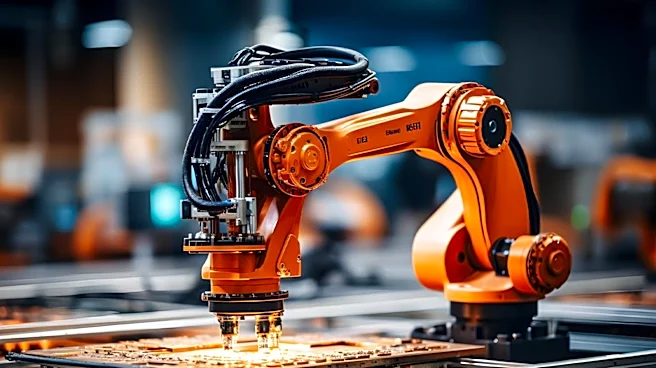
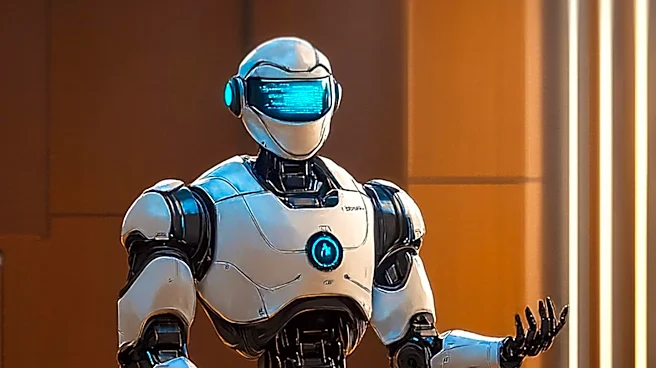
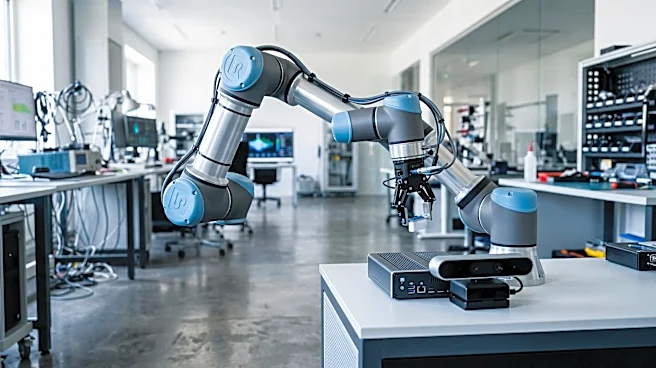
physical embodiments. WorldGPT is presented as the first world model capable of prediction and action planning across six types of embodiments: vehicles, boats, drones, single-arm robots, dual-arm robots, and humanoids. The primary objective is to unify disparate capabilities from these different systems into a single foundation model for training. This approach aims to significantly reduce the marginal cost associated with developing new embodiments. The model processes historical camera feeds and commands to generate future video, actions, visual tasks, and language reasoning, providing explanations for its decisions. Training occurs in the cloud using data from all six embodiment categories, after which the intelligence is distilled into smaller, edge-based models tailored for each specific embodiment.
Why It's Important?
WorldGPT represents a significant shift from the traditional 'one machine, one stack' paradigm in physical AI, where each embodiment (e.g., vehicles, robotic arms) required its own bespoke system. This fragmentation led to increased costs, siloed data, and an inability to directly transfer actions between different types of machines. By using vision as a common language, WorldGPT pools fragmented data for cross-embodiment training, extracting shared world knowledge and a universal action intuition. This unified approach could lead to more efficient development and deployment of AI across diverse robotic and autonomous systems. For industries relying on robotics, such as manufacturing, logistics, and autonomous transportation, this could mean faster innovation cycles and reduced development expenses. The ability to transfer learned intelligence across different machine types could accelerate the adoption of advanced AI in various sectors, potentially impacting operational efficiency and automation levels.
What's Next?
XPENG's WorldGPT is expected to streamline the development process for new embodiments. Under this framework, integrating a new machine type will primarily require specialization, involving a small amount of specific data to calibrate control details and map the unified physical intelligence to its unique execution elements. This contrasts with the previous method of repeating the entire pipeline of data collection, model training, and deployment debugging for each new embodiment. The company reports that WorldGPT has already achieved top rankings in four public evaluations for autonomous driving, covering open-loop, semi-closed-loop, and closed-loop assessments. In robotic manipulation, the model demonstrated strong generalization, achieving an average success rate of 95.2% across 50 single-arm tasks. These results suggest that the technology is moving towards practical application, potentially leading to more versatile and adaptable AI-powered systems in the near future.
Beyond the Headlines
The development of WorldGPT highlights a broader trend in artificial intelligence towards more generalized and transferable learning across diverse physical systems. The concept of a cloud-based teacher model distilling knowledge to multiple edge-based student models addresses the inherent tension between the need for substantial model capacity for comprehensive capabilities (perception, reasoning, prediction, action) and the constraints of edge computing power, energy consumption, and real-time performance. This architecture allows for the training of large, complex models in the cloud while enabling efficient deployment of smaller, specialized models on individual devices. This approach could foster greater interoperability among different types of AI-driven machines and potentially lead to the creation of more sophisticated, multi-functional robotic systems that can adapt to a wider range of tasks and environments with reduced development overhead. The emphasis on vision as a unifying factor underscores its critical role in the future of physical AI.