






What's Happening?
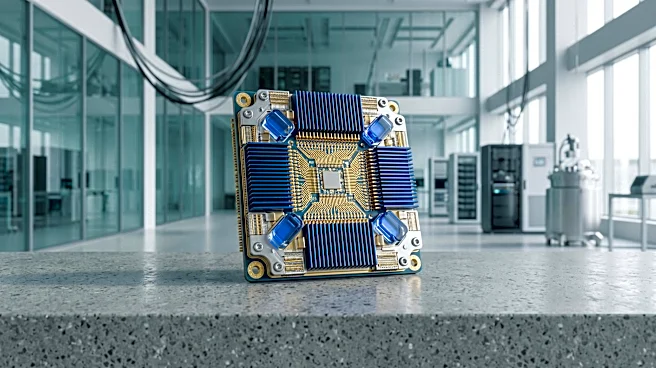
Diraq, a quantum computing pioneer, has successfully deployed its silicon spin quantum computer within a commercial data center operated by Equinix in Sydney, Australia. This marks the first instance of such a system operating live within existing digital
infrastructure. The deployed system currently features eight qubits, with Diraq planning to upgrade it to over 200 qubits within a year through a chip upgrade, without requiring changes to the surrounding infrastructure. This development is considered a significant step towards making quantum computing commercially viable and accessible. Andrew Dzurak, CEO and Founder of Diraq, emphasized that this move brings quantum computing closer to various industries, including medicine, materials, and logistics. The company's silicon spin approach utilizes standard semiconductor manufacturing processes, allowing for scalability and cost-effectiveness.
Why It's Important?
The deployment of Diraq's quantum computer in a commercial data center is a pivotal moment for the quantum computing industry, demonstrating a practical pathway for integrating this advanced technology into everyday business operations. By leveraging existing digital infrastructure, Diraq aims to overcome some of the significant barriers to quantum computing adoption, such as high infrastructure costs and complex deployment requirements. This approach could accelerate the development and application of quantum solutions across various sectors, potentially leading to breakthroughs in drug discovery, materials science, and complex logistical optimization. The ability to scale qubits with minimal infrastructure changes also suggests a more rapid and cost-efficient path to utility-scale quantum computing, which could unlock substantial economic value, as highlighted by Boston Consulting Group's estimate of an additional $3.5 trillion at maturity.
What's Next?
Diraq plans to upgrade its deployed system to over 200 qubits within the next year, a crucial step towards achieving utility-scale quantum computing. The company is also launching 'Quantum at Work,' a report that will explore how quantum computing can address global challenges in fields like medicine, energy, climate, and transport. This initiative aims to outline the future capabilities of utility-scale quantum computers and their potential impact. Furthermore, Diraq's participation in DARPA's Quantum Benchmarking Initiative and its letter of intent for funding under the CHIPS and Science Act indicate continued governmental and strategic support, which could further accelerate its research and development efforts and commercialization timeline. The success of this deployment could also encourage other quantum computing companies to explore similar integration strategies.
Beyond the Headlines
This development signifies a shift in the quantum computing paradigm, moving it from purely theoretical research labs to practical, integrated environments. The use of silicon spin technology, compatible with existing semiconductor manufacturing, suggests a future where quantum processors could be produced at industrial scale, similar to conventional computer chips. This could democratize access to quantum computing capabilities, making it available to a broader range of businesses and researchers. The emphasis on compact, low-power systems also addresses environmental concerns associated with the energy demands of some quantum technologies. This integration could foster a new era of hybrid computing, where quantum and classical systems work in tandem, potentially leading to unprecedented computational power and solving problems currently beyond the reach of even the most powerful supercomputers.