




What's Happening?
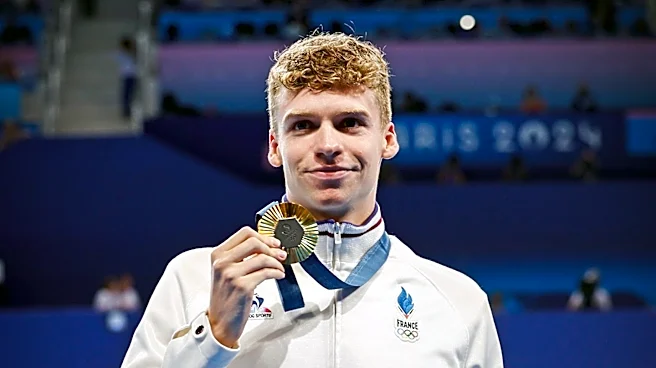
French Olympic swimming star Léon Marchand has recently experienced significant criticism on social media after he chose not to express a political opinion during a television interview. Marchand, who won four gold medals and one bronze at the Paris 2024
Olympic Games, was asked about politics, the upcoming presidential election, and the stances of other French athletes. He stated that he did not feel legitimate to comment and did not want to say 'just anything.' This refusal to engage politically led to a 'shitstorm' on social media, where he was labeled with derogatory terms such as 'bourgeois, privileged, white, cowardly, fascist, racist' by some users. The incident highlights a growing trend where public figures face intense scrutiny and backlash for not aligning with specific expectations regarding political discourse, even when they opt for neutrality.
Why It's Important?
This event underscores the increasing pressure on public figures, particularly athletes, to take political stances, and the severe consequences they can face on social media if they choose not to. For U.S. athletes and public figures, this situation serves as a cautionary tale regarding the potential for online vitriol, regardless of their intentions. The expectation for celebrities to be politically vocal can lead to a no-win situation: speaking out can alienate some fans, while remaining silent can provoke accusations of apathy or complicity. This dynamic can impact endorsement deals, public image, and mental well-being, forcing individuals to navigate a complex landscape where their personal views are constantly under public scrutiny. The incident also reflects a broader societal trend where social media platforms amplify both support and condemnation, making it difficult for individuals to maintain a private sphere for their political beliefs.
What's Next?
In the immediate future, Marchand will likely continue to navigate the aftermath of this social media controversy. While he has not publicly responded to the specific criticisms, the incident may influence how he and other public figures approach media interactions, particularly concerning sensitive topics. There could be increased discussions within sports organizations and public relations circles about strategies for athletes to manage their public image and respond to political questions in an increasingly polarized environment. The incident may also prompt a broader conversation about the role of athletes in political discourse and the boundaries of public expectation. For Marchand, his focus will likely return to his athletic career, including a planned swim school in Nagoya ahead of the 20th Asian Games, as he continues to be a prominent figure in international swimming.
Beyond the Headlines
Beyond the immediate social media storm, this incident touches upon deeper issues of free speech, public expectation, and the nature of celebrity in the digital age. It raises questions about whether public figures have a moral obligation to use their platform for political advocacy, or if they have the right to abstain without facing severe public condemnation. The rapid and often aggressive nature of online backlash, as seen in Marchand's case, highlights the challenges of maintaining nuance and respectful dialogue in digital spaces. This phenomenon can lead to a chilling effect, where individuals self-censor to avoid becoming targets, potentially stifling diverse perspectives. The incident also reflects a cultural shift where the lines between personal and public life for celebrities are increasingly blurred, and where silence can be interpreted as a political statement in itself, regardless of intent.