





What's Happening?
Stellantis, a major automotive group, has significantly reduced its car development timeline to just two years. This accelerated development cycle is a direct result of a collaboration with its Chinese partner, Leapmotor. The partnership involves Stellantis engineers
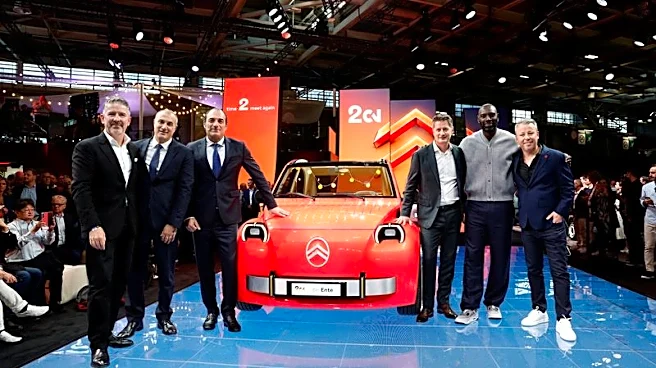
working alongside their Chinese counterparts at the Mirafiori complex in Turin. While European teams contribute their expertise in designing small cars for the European market, Leapmotor is sharing methods for rapid vehicle development. This strategic shift is particularly aimed at enabling Stellantis to bring affordable electric vehicles to market, with initial models expected to be priced under 15,000 euros. The first models developed under this new approach, potentially including a new Citroën 2CV and a small electric Fiat, are slated for production starting in 2028 at the Stellantis plant in Pomigliano d’Arco, Italy. The E-Car project, as it's known, will utilize a new architecture developed in this collaborative effort.
Why It's Important?
This development marks a significant transformation for Stellantis and has broader implications for the U.S. automotive industry and global manufacturing strategies. By adopting a two-year development cycle, Stellantis is challenging traditional, much longer European automotive development timelines. This efficiency gain could allow the company to respond more quickly to market demands, particularly in the rapidly evolving electric vehicle (EV) sector. For U.S. consumers, this could mean a faster introduction of new, potentially more affordable EV models, increasing competition and choice. The collaboration also highlights a growing trend of Western automakers leveraging Chinese manufacturing and development expertise to enhance their own capabilities, especially in cost-effective EV production. This could influence other U.S. and international manufacturers to explore similar partnerships, potentially reshaping global automotive supply chains and development processes. The ability to produce EVs at a lower cost could also accelerate the transition to electric vehicles, impacting energy policy and infrastructure development.
What's Next?
Stellantis plans to introduce at least two, and possibly three, new models based on this accelerated development process, with production commencing in 2028. The initial models are expected to include a new Citroën 2CV and a small electric Fiat, potentially referred to as the 'Koala,' manufactured in Italy. The exact identity of a potential third vehicle is yet to be officially confirmed, with possibilities including a new Leapmotor T03 or an Opel model. The success of these initial vehicles will likely determine the extent to which Stellantis further integrates this rapid development methodology across its brand portfolio. Other major automotive players will be closely observing Stellantis's ability to maintain quality and innovation while significantly shortening development cycles. This shift could also lead to increased investment in manufacturing facilities capable of supporting faster production timelines and potentially influence regulatory discussions around vehicle safety and emissions standards as development speeds up.
Beyond the Headlines
The collaboration between Stellantis and Leapmotor extends beyond mere technological exchange; it represents a cultural and operational shift within a major European automaker. The 'learning from the Chinese pace' signifies a re-evaluation of established industry practices and a willingness to adopt more agile, cost-efficient methods. This could lead to a broader redefinition of what constitutes 'European' or 'Western' automotive manufacturing, as global partnerships increasingly blur traditional geographical and operational boundaries. The focus on affordable electric vehicles also addresses a critical market need, potentially democratizing EV ownership and accelerating global decarbonization efforts. However, it also raises questions about intellectual property sharing, the integration of diverse corporate cultures, and the long-term implications for employment in traditional automotive design and engineering roles in Europe and the U.S. The ability to quickly bring new models to market could also intensify competition, potentially leading to faster product obsolescence and new challenges for aftermarket support and parts availability.