









What's Happening?
NanoString, a company specializing in spatial biology techniques, has continued its operations under Bruker's ownership following a Chapter 11 bankruptcy filing and subsequent acquisition. Bruker acquired substantially all of NanoString's business assets
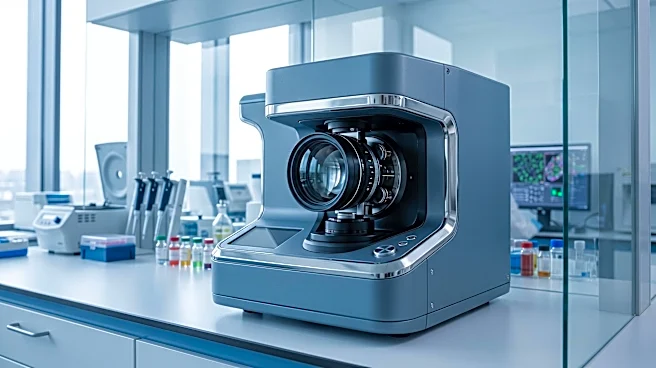
for approximately $392.6 million in cash in May 2024. NanoString's core proposition is that location is critical in biological measurements, allowing researchers to investigate the spatial arrangement of molecules within tissue sections. Their platforms, including the GeoMx Digital Spatial Profiler and CosMx Spatial Molecular Imager, enable scientists to analyze molecular tags from selected regions of tissue or at single-cell and subcellular resolution. The company's nCounter Analysis System also performs direct digital counting for targeted gene expression. This acquisition ensures the continuity of these advanced research tools for the scientific community.
Why It's Important?
The acquisition of NanoString by Bruker is significant for the U.S. biotechnology and research sectors. NanoString's spatial biology tools are crucial for understanding complex biological environments, such as tumors, where the proximity of different cell types can influence disease progression. By preserving the spatial arrangement of molecules, these platforms provide insights that bulk measurements cannot, aiding in biomarker discovery and the development of targeted therapies. The financial challenges faced by NanoString, despite its scientific adoption, highlight the intense competition and high costs associated with developing and commercializing cutting-edge research instruments. Bruker's acquisition ensures that these valuable technologies remain available to academic, pharmaceutical, and biotechnology researchers, preventing a disruption in critical research capabilities.
What's Next?
Under Bruker's ownership, NanoString's research platforms, including GeoMx, CosMx, and nCounter, will continue to be developed and supported. Bruker has already expanded collaborations, such as with Noetik, following CosMx studies on patient samples, and announced new workflows connecting its various spatial biology tools. The company will likely focus on integrating NanoString's technologies within its broader portfolio and expanding their applications in various research fields. Researchers will continue to access these tools through shared facilities and direct purchases, with ongoing support for assays, consumables, and analysis offerings. The patent settlement between Bruker and 10x Genomics in May 2025, involving a payment and cross-licensing arrangements, further stabilizes the operating environment for these products.
Beyond the Headlines
The evolution of NanoString, from its founding in 2003 to its acquisition by Bruker, underscores the dynamic and often challenging landscape of scientific innovation. The company's journey highlights the tension between groundbreaking scientific utility and financial sustainability in the highly competitive life sciences industry. The emphasis on spatial biology represents a fundamental shift in how biological questions are approached, moving towards a more holistic understanding of cellular interactions within their native tissue context. This trend is not just about new instruments but also about the development of sophisticated computational tools to analyze the vast amounts of spatial data generated. The continued availability and advancement of these technologies are pivotal for accelerating discoveries in precision medicine, ultimately benefiting patient care.