




What's Happening?
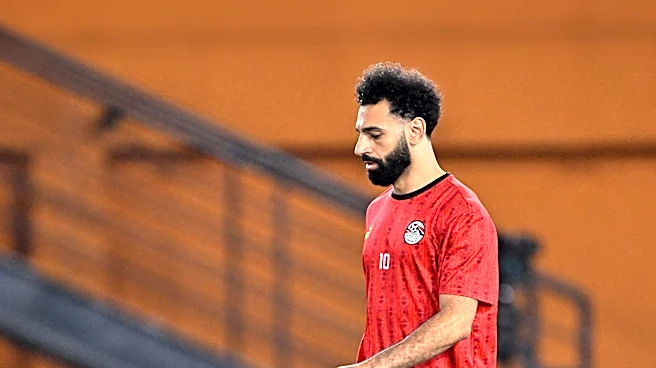
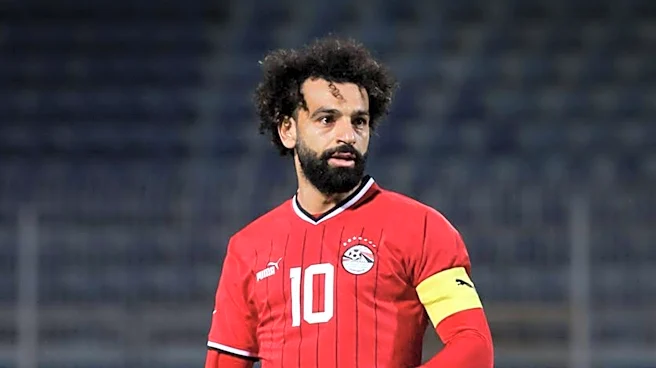
A discrepancy has emerged between the Egyptian Football Federation (EFA) and FIFA regarding the official number of international goals scored by Mohamed Salah, captain of the Egyptian national team. Following a 5-0 victory over Malawi, where Salah scored two
goals, the EFA celebrated him as Egypt's all-time leading scorer with 70 goals, surpassing Hossam Hassan's 69. However, FIFA subsequently updated its records, stating Salah has 68 goals, thereby maintaining Hossam Hassan as the record holder. This disagreement stems from a 2013 friendly match against Swaziland (now Eswatini) where Salah scored twice, but FIFA did not recognize the match as an official 'A' international due to an excessive number of substitutions made by the Egyptian team. The FIFA website had previously shown Salah with 68 goals in June, then adjusted it to 66 before the Malawi match, and now confirms 68 after his recent brace.
Why It's Important?
This statistical dispute highlights the complexities and varying criteria used by national and international football bodies for record-keeping. For Mohamed Salah, a globally recognized football star, the official recognition of his achievements carries significant weight for his legacy and national pride. The EFA's celebration of Salah as the record holder, contrasted with FIFA's stance, creates confusion and potentially undermines the credibility of official statistics. This situation could also impact future player incentives, endorsements, and historical narratives within Egyptian football. The debate underscores the need for clear, consistent, and universally accepted guidelines for classifying international matches and player statistics, especially in an era where such records are closely scrutinized and celebrated by fans worldwide.
What's Next?
The Egyptian Football Federation and FIFA will likely need to engage in further discussions to resolve the discrepancy in Mohamed Salah's goal count. The EFA's public celebration of Salah's 70 goals suggests they will continue to advocate for their interpretation of the statistics. FIFA, on the other hand, has maintained its position based on its criteria for official 'A' international matches. This situation could lead to a formal appeal or request for clarification from the EFA to FIFA. The outcome will determine whether Salah is officially recognized as Egypt's all-time leading scorer, a title currently held by Hossam Hassan according to FIFA's records. The ongoing debate will continue to be a point of discussion among football fans and media.
Beyond the Headlines
The controversy surrounding Mohamed Salah's goal count extends beyond mere statistics, touching upon issues of national identity and the interpretation of sporting history. For Egyptian football fans, Salah represents a modern icon, and the potential for him to hold the all-time scoring record is a source of immense pride. The differing tallies from the EFA and FIFA could lead to a dual narrative, where local records diverge from international ones, potentially causing long-term confusion. This situation also raises questions about the transparency and accessibility of official match data and the criteria used to validate international fixtures. The debate could prompt a broader review of how such records are maintained and communicated globally, ensuring consistency and avoiding similar disputes for other players and national teams.