






What's Happening?
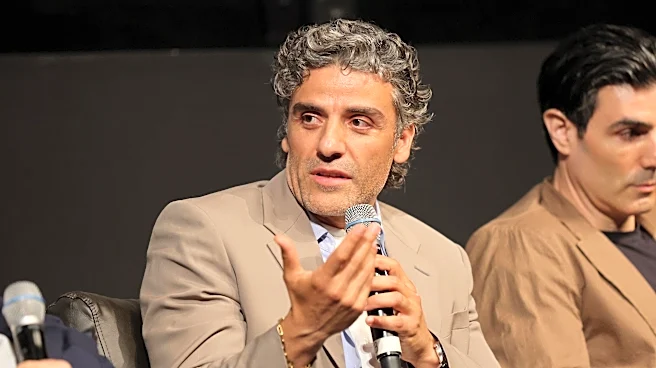
Oscar Isaac, the acclaimed actor known for his roles in 'Star Wars' and 'Dune,' has spoken about his Guatemalan and Cuban heritage, emphasizing his pride in his roots while also expressing discomfort with being a spokesperson for any specific group. Born
in Guatemala City on March 9, 1979, Isaac moved to the United States at five months old. He trained at the Juilliard School and began his career in New York theater before gaining prominence in films like 'Inside Llewyn Davis' (2013), 'A Most Violent Year' (2014), and 'Ex Machina' (2015). His career further expanded with major commercial roles such as Poe Dameron in the 'Star Wars' sequel trilogy, Duke Leto Atreides in 'Dune' (2021), and the voice of Miguel O’Hara in 'Spider-Man: Across the Spider-Verse' (2023). Isaac, whose full name is Óscar Isaac Hernández Estrada, shortened it for professional reasons, citing simplicity on posters and a deeper personal rationale. He admires actors like Raúl Juliá, who he noted was a Latino actor not confined to solely playing Latino roles.
Why It's Important?
Isaac's stance highlights a significant discussion within the entertainment industry regarding representation and the expectations placed on minority actors. His refusal to be a 'spokesperson' for the Latin American community, despite his pride in his heritage, underscores the individual agency actors seek in defining their public roles. This perspective challenges the notion that successful individuals from underrepresented groups must automatically assume a leadership role for their entire community. It also brings to light the ongoing conversation about typecasting in Hollywood, where actors of color often face pressure to portray characters solely defined by their ethnicity. Isaac's admiration for Raúl Juliá, who transcended such limitations, reflects a desire among many actors for roles that offer broader artistic expression beyond ethnic stereotypes. This contributes to a larger dialogue about how the industry can foster more diverse and nuanced portrayals of characters from all backgrounds.
What's Next?
The conversation sparked by Isaac's comments is likely to continue influencing discussions within Hollywood about representation, authenticity, and the responsibilities of public figures. As the industry increasingly focuses on diversity and inclusion, actors from various backgrounds may feel empowered to define their own terms of engagement with their heritage and public image. This could lead to more nuanced portrayals of characters and a greater push for roles that are not solely defined by ethnicity. Furthermore, Isaac's continued success in diverse roles across major franchises may serve as an example for emerging actors, demonstrating that it is possible to maintain a strong connection to one's heritage while pursuing a wide range of artistic opportunities without being confined to specific representational duties. The industry may also see more actors advocating for roles that break traditional molds, inspired by figures like Isaac and Juliá.
Beyond the Headlines
Isaac's reflections touch upon deeper themes of identity, belonging, and the burden of representation. For many individuals from immigrant backgrounds or minority groups, there is often an internal and external pressure to embody the experiences and speak for their entire community. Isaac's perspective offers a counter-narrative, emphasizing individual identity over collective representation, which can be liberating for artists who wish to explore a broader spectrum of human experience in their work. This also raises ethical questions about the media's role in assigning representational duties to public figures. While visibility is crucial, the expectation that every successful individual from a minority group must become a political or cultural ambassador can be overwhelming and limit artistic freedom. Isaac's nuanced approach encourages a more complex understanding of identity in the public sphere, where individuals can celebrate their heritage without being confined by it.