

What's Happening?
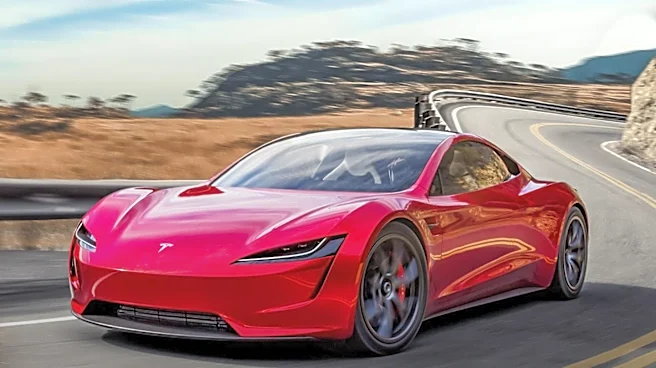
Tesla showcased the second-generation Roadster's advanced capabilities in an October 15, 2026 demonstration near Waco, Texas. The vehicle performed an upside-down drive, a mid-air flip, and a controlled landing. These maneuvers were achieved using a multi-mode
suction or ground-sealing system, fans, and cold-gas thrusters supplied by SpaceX. Tesla announced three configurations for the Roadster: Performance, Thrust, and Rocket. The Performance trim is a two-seat, road-oriented car with active aerodynamics and the suction system, claiming a 0-60 mph time under 1.6 seconds with a $50,000 reservation deposit. The Thrust trim adds rear cold-gas thrusters, achieving under 0.9 seconds to 60 mph, with a $250,000 deposit. The Rocket trim is a single-seat, invitation-only version with thrusters positioned around the vehicle, claiming under 0.59 seconds to 60 mph. While the demonstration highlighted extreme performance, Tesla has not confirmed road legality, production status, commercial availability, or sustained flight capabilities.
Why It's Important?
This demonstration is significant for Tesla's brand image and its positioning as a technology leader in the automotive industry. By showcasing such extreme and novel capabilities, Tesla reinforces its reputation for innovation and pushes the boundaries of what is perceived as possible for a production vehicle. The integration of SpaceX technology, particularly the cold-gas thrusters, further links Tesla to advanced engineering and aerospace innovation, potentially enhancing consumer perception of its technological prowess. The high reservation deposits for the Thrust and Performance trims could generate substantial capital for Tesla, even before production begins, providing financial flexibility. However, the ambitious claims and the nature of the demonstration also set high expectations for the production model, which could lead to consumer disappointment if the final product does not fully deliver on these advanced features or if regulatory hurdles limit their use on public roads.
What's Next?
Tesla has set a 2028 production target for the Roadster, though this is a target and not a confirmed production-start date. Before commercial availability, Tesla will need to address significant engineering and regulatory challenges, especially concerning the safety and legality of features like inverted driving and thruster use on public roads. Regulators will likely need to establish new guidelines for such unprecedented vehicle capabilities. Consumers and investors will be watching for official specifications, regulatory filings, and independent performance tests to validate Tesla's claims. The company will also need to clarify details regarding battery capacity, range, power, torque, and the final purchase price for each trim. Further demonstrations or detailed engineering disclosures might be released to address skepticism and maintain public interest as the production timeline approaches.
Beyond the Headlines
The Roadster's demonstration pushes the boundaries of automotive engineering, blurring the lines between conventional vehicles and more advanced propulsion systems. The use of suction and thrusters introduces novel concepts for vehicle control and performance, potentially influencing future automotive design beyond hypercars. Ethically, the implications of such extreme performance capabilities on public roads will be a key discussion point for regulators and safety advocates. The integration of SpaceX technology into a consumer vehicle also highlights the growing synergy between different sectors of Elon Musk's ventures, potentially leading to cross-industry innovations. Long-term, if these technologies prove viable and safe, they could redefine expectations for vehicle dynamics, safety systems, and even emergency maneuvers, although widespread adoption would likely be many years away and subject to rigorous testing and regulatory approval.