







What's Happening?
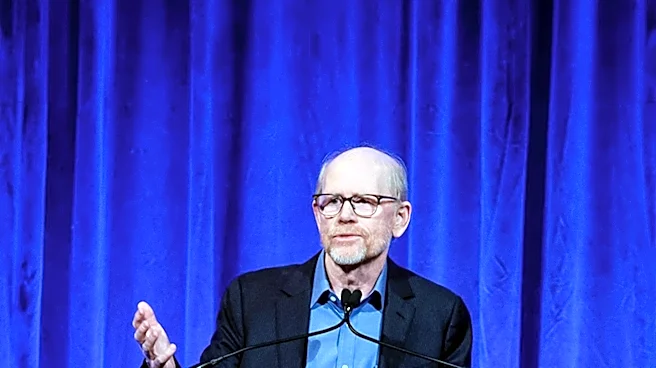
Ron Howard, a prominent figure in the film industry, faced significant challenges at the outset of his directorial career with the 1977 comedy film 'Grand Theft Auto.' Despite having acted since the age of five in productions like 'The Andy Griffith Show'
and 'The Twilight Zone,' Howard struggled to transition into directing due to a lack of experience. His opportunity to direct 'Grand Theft Auto' arose because director and producer Roger Corman owed him a favor. The film was made on a shoestring budget and came with strict commercial requirements from Corman, including a car-chase action-comedy featuring young people and a pre-tested title. Howard, then 23, was tasked with directing and starring in the film, working with a mediocre script. The first day of shooting was particularly stressful for Howard, who felt he was falling behind schedule and feared being fired. He managed only four or five setups during the first half of the day, leading to significant anxiety about his future as a filmmaker.
Why It's Important?
This early struggle in Ron Howard's career highlights the immense pressure and inherent difficulties faced by aspiring filmmakers, even those with prior acting experience and industry connections. The story underscores the commercial realities of the film industry, where creative freedom can be constrained by budgetary limitations and producer demands. Howard's experience with 'Grand Theft Auto' demonstrates that even established actors transitioning to directing must prove their capabilities under challenging circumstances. The intervention of cinematographer Gary Graver, who helped Howard simplify problems and avoid potential pitfalls, illustrates the critical role of collaboration and mentorship in the demanding environment of film production. Without Graver's support, Howard might have abandoned his directorial aspirations, which would have deprived audiences of his later acclaimed works, including Oscar-winning films. This narrative emphasizes the fragility of early careers and the profound impact that key individuals can have on an artist's trajectory.
What's Next?
While 'Grand Theft Auto' itself was not a significant highlight in Ron Howard's career, its production served as a crucial learning experience that shaped his approach to filmmaking. The lessons learned from navigating commercial expectations, managing a tight budget, and overcoming on-set difficulties likely contributed to his development as a director. Howard's subsequent career saw him direct numerous successful films, including 'Apollo 13,' 'A Beautiful Mind,' and 'Frost/Nixon,' with 'A Beautiful Mind' earning him an Academy Award for Best Director. His continued involvement in the entertainment industry, including his role as chairman of the Corporation for Public Broadcasting and directing episodes of 'The Voice,' demonstrates a sustained and evolving career. The experience of 'Grand Theft Auto' underscores the foundational importance of early, challenging projects in building resilience and practical skills for a long-term career in a competitive field.
Beyond the Headlines
Ron Howard's initial foray into directing with 'Grand Theft Auto' offers a deeper insight into the psychological and professional hurdles faced by individuals striving to establish themselves in creative industries. The pressure Howard felt, believing his entire future as a filmmaker hinged on this one project, reflects a common sentiment among emerging artists. His anxiety, despite appearing calm to others like Roger Corman, reveals the internal struggle often masked by external composure. This narrative also subtly critiques the industry's tendency to prioritize commercial viability over artistic exploration, especially for new directors. The reliance on a cinematographer like Gary Graver to 'save' his career highlights the often-unseen support systems and collaborative spirit essential for creative success. It suggests that even the most celebrated figures often have pivotal, uncredited mentors or colleagues who provide crucial guidance during formative periods, shaping not just individual careers but also the broader landscape of cinematic output.