



What's Happening?
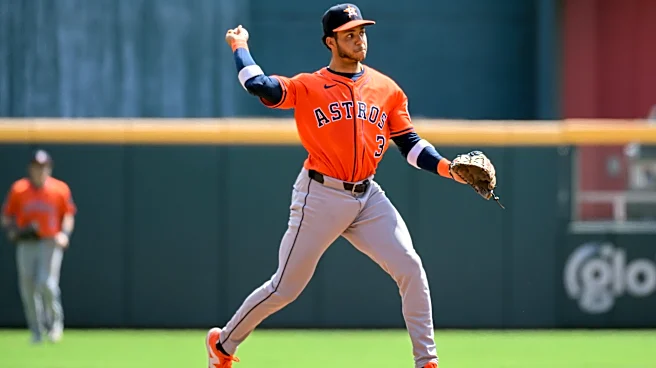
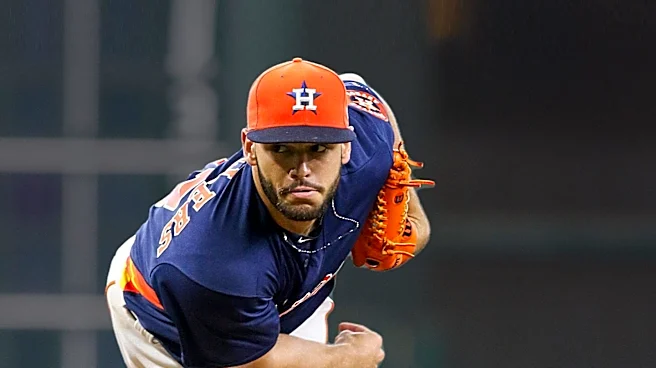
The Houston Astros faced a challenging start to their season, marked by numerous pitching injuries, including an early-season right shoulder strain that sidelined pitcher Hunter Brown. This injury compounded an already difficult situation for the team,
which saw several other key pitchers out due to various ailments, such as Tommy John surgery recoveries for Hayden Wesneski, Brandon Walter, and Ronel Blanco, as well as other issues affecting Josh Hader, Bennett Sousa, Nate Pearson, and Enyel De Los Santos. Despite these significant setbacks and a constantly thinning staff, the Astros were compelled to utilize a club-record 19 starting pitchers. Hunter Brown, prior to his injury, had demonstrated solid performance, recording a 3.19 ERA over 20 starts and 107.1 innings pitched, securing a 6-4 record. His absence, alongside other key players, significantly impacted the team's pitching depth and overall performance during the initial phase of the season.
Why It's Important?
Hunter Brown's early-season shoulder strain highlights the critical impact of pitcher health on a Major League Baseball team's performance and strategic planning. For the Astros, losing a pitcher of Brown's caliber, who maintained a respectable 3.19 ERA in 20 starts, created a substantial void in their rotation. This situation forced the team to rely on an unprecedented number of starting pitchers, which can lead to instability and inconsistency on the mound. The ripple effect of such injuries extends beyond immediate game outcomes, influencing player development, bullpen usage, and potential trade decisions. Teams often have to dip into their minor league systems or make costly acquisitions to compensate for unexpected losses, affecting long-term financial and roster flexibility. The reliance on a high number of starters also puts additional strain on the remaining healthy pitchers, increasing their workload and potentially leading to further injuries, creating a challenging cycle for team management.
What's Next?
With many of the injured players, including Hunter Brown, expected to return from the injured list, the Astros anticipate starting the 2027 season with a healthier and more robust pitching staff. The focus will likely be on integrating these returning pitchers back into the rotation and ensuring their sustained health throughout the season. The team will need to assess how Brown's recovery impacts his performance and whether he can return to his previous form. The Astros also face the challenge of solidifying their rotation around key performers like Peter Lambert, who stepped up significantly in the absence of others. The upcoming season will be crucial for the Astros to demonstrate if their returning talent can provide the consistency and depth needed to compete at a high level, especially after a season marked by extensive pitching challenges.
Beyond the Headlines
The Astros' experience with a multitude of pitching injuries, including Hunter Brown's shoulder strain, underscores a broader trend in professional baseball regarding pitcher health and workload management. The increasing velocity and intensity of modern pitching often lead to higher rates of arm injuries, prompting ongoing discussions about pitch counts, rest protocols, and biomechanical analysis. This situation also highlights the strategic importance of organizational depth in pitching, as teams with strong minor league systems are better equipped to absorb such losses. The long-term implications for players like Brown involve not only their immediate recovery but also the psychological and physical challenges of returning to elite performance after a significant injury. For the sport as a whole, these recurring injury patterns may drive further innovation in training methods, injury prevention, and player development strategies to protect valuable assets and maintain competitive integrity.