






What's Happening?
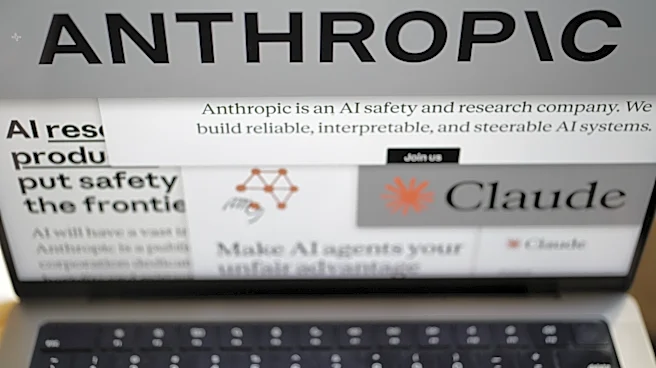
Anthropic, the AI company behind the Claude chatbot, is set to go public on the U.S. stock market with an unusual IPO structure. The company, a 'public benefit corporation,' aims to balance stockholder interests with its fundamental goal of 'the responsible
development and maintenance of advanced AI for the long-term benefit of humanity.' To achieve this, Anthropic has established a long-term benefit trust with the power to elect or remove a majority of the company's board of directors. Additionally, the seven co-founders, including CEO Dario Amodei and President Daniela Amodei, will receive a special class of stock that grants them 50.1% of the voting power of all outstanding shares. This structure ensures that the founders, as a group, can dictate issues put before shareholders, such as a potential company sale, effectively giving them control over the company's direction.
Why It's Important?
This unique IPO structure has significant implications for investors and the broader AI industry. While Anthropic aims to attract investment, its commitment to balancing profit with AI safety could lead to strategies that may not always maximize financial returns for shareholders in the short term. The founders' retained voting control, through their special stock class, means that traditional investor influence might be limited, potentially deterring some investors seeking purely profit-driven ventures. This approach reflects a growing concern within the tech industry about the ethical development and societal impact of powerful AI technologies. The success or failure of Anthropic's IPO and its subsequent performance will serve as a crucial test case for how public benefit corporations, particularly in the high-stakes AI sector, can navigate the demands of both financial markets and ethical responsibilities.
What's Next?
Anthropic's stock will begin trading later this week, and its performance will be closely monitored by the market. The company expects up to 20% of its Class A shares in the IPO to go to retail investors, a higher percentage than most IPOs, indicating an effort to broaden its investor base. The company's ability to join major indices like the Nasdaq 100 and eventually the S&P 500 will depend on its market capitalization and trading history. The long-term benefit trust and the founders' voting control will continue to shape the company's strategic decisions, potentially influencing its research priorities, product development, and partnerships. The market's reaction to this unusual governance model will provide insights into how investors value companies that prioritize social benefit alongside financial growth in the rapidly evolving AI landscape.
Beyond the Headlines
Anthropic's decision to implement such a governance structure reflects a deeper societal conversation about the power and potential risks of advanced AI. By embedding a long-term benefit trust and granting founders super-voting shares, the company is attempting to institutionalize its commitment to responsible AI development, even at the expense of potentially higher short-term profits. This move could inspire other AI companies to consider similar structures, fostering a new paradigm where ethical considerations are formally integrated into corporate governance. However, it also raises questions about accountability and transparency, as the founders' significant control could limit external oversight. The ongoing debate about AI safety, the potential for recursive self-improvement, and the need for regulation will likely be influenced by how Anthropic's unique model plays out in the public market, potentially setting new standards for corporate responsibility in the AI era.