






What's Happening?
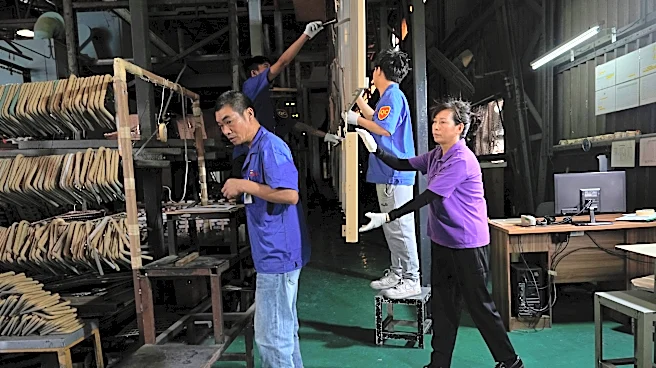
China's factory activity expanded in September, marking a return to growth after a two-month contraction. The official manufacturing Purchasing Managers' Index (PMI) rose to 50.1 from 49.8 in August, aligning with analysts' forecasts. This modest expansion
was primarily driven by accelerated activity in equipment and high-tech manufacturing, as well as consumer industries, according to National Bureau of Statistics chief statistician Huo Lihui. The non-manufacturing PMI also saw an increase to 50.2, indicating a pickup in the services sector and reaching its highest level this year in the construction sector. This rebound follows a period of economic slowdown characterized by sluggish domestic demand and investment, partly due to weaknesses in the property sector. In response, China's top economic and financial policymakers have introduced targeted fiscal and monetary measures, including mortgage subsidies for qualified homebuyers and expanded central bank lending for infrastructure projects and specific sectors like technology and small firms. These measures are viewed as a 'mini stimulus' aimed at achieving the country's 4.5%-5% growth target for the year.
Why It's Important?
The resurgence in China's factory activity is significant for the global economy, including the U.S., given China's role as a major trading partner for over 160 countries and a crucial link in global supply chains. A stable and growing Chinese economy contributes to the predictability of international commerce and the security of global supply chains. For the U.S., continued economic stability in China can help maintain bilateral trade, especially with recent improvements in U.S.-China relationships, such as the extension of a trade truce. However, concerns persist regarding China's excess manufacturing capacity and heavy reliance on foreign demand, while domestic consumption lags. This imbalance could lead to trade tensions if China's exports continue to outpace internal demand, potentially affecting U.S. industries that compete with Chinese goods. The focus on high-tech manufacturing and AI hardware in China's growth also highlights the ongoing technological competition between the two nations, with implications for global innovation and supply chain resilience.
What's Next?
Chinese policymakers are expected to continue implementing targeted stimulus measures to sustain economic growth and address underlying issues such as weak domestic consumption and property sector challenges. The effectiveness of these 'mini stimulus' efforts in boosting broader economic activity beyond exports will be closely watched. Economists project China's real GDP growth to pick up in the final two quarters of the year, but the long-term impact of these measures on rebalancing the economy towards domestic demand remains to be seen. The extension of the U.S.-China trade truce until January suggests a continued period of cautious engagement, but the future of trade relations beyond this period is uncertain. The ongoing global AI hardware boom is likely to further drive China's high-tech manufacturing sector, potentially intensifying the technological competition with the U.S. and influencing global supply chains for advanced components.
Beyond the Headlines
The rebound in China's factory activity, while positive for immediate economic indicators, also underscores deeper structural challenges within the Chinese economy. The reliance on exports and government-led stimulus to drive growth, rather than robust domestic consumption, points to a potential vulnerability. This approach could exacerbate global concerns about overcapacity in certain sectors, leading to increased trade friction with countries like the U.S. Furthermore, the emphasis on high-tech manufacturing and AI development reflects China's strategic ambition to move beyond being the 'world's factory' to a global innovation powerhouse. This shift has profound implications for global technological leadership and could reshape international economic and geopolitical dynamics. The U.S. will need to navigate this evolving landscape, balancing economic engagement with strategic competition, particularly in critical technology sectors, to ensure its own economic security and technological advantage.