



What's Happening?
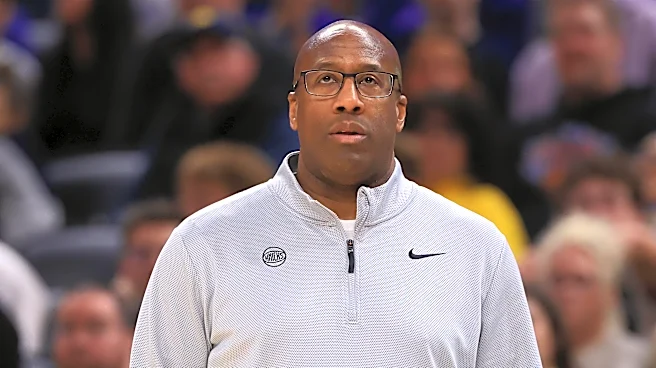
Mike Brown, the head coach of the New York Knicks, has demonstrated an unparalleled level of flexibility in his coaching approach, a trait that has significantly contributed to the team's success during his tenure. Despite a previous reputation as a rigid
'drillmaster' and a stickler for order, Brown's current style is characterized by adaptability. This evolution in his coaching philosophy is noted after more than a season and a championship with the Knicks, suggesting a departure from the traits confirmed by Eric Musselman, who coached alongside Brown in the Lakers organization during the 2011-12 season. His 34 years of total NBA coaching experience, at only in his mid-50s, indicate a long career that has allowed for this development.
Why It's Important?
Mike Brown's adaptable coaching style is crucial for the New York Knicks, as it allows the team to respond effectively to the dynamic challenges of the NBA season, including player injuries, opponent strategies, and team performance fluctuations. This flexibility can foster a more resilient and responsive team culture, potentially leading to sustained success and improved player development. For the broader NBA, Brown's evolution challenges the perception that coaches must adhere to a single, fixed methodology. It highlights the importance of continuous learning and adaptation in leadership roles, especially in high-pressure environments. This approach can influence other coaches to re-evaluate their own methods, potentially leading to more innovative and player-centric coaching strategies across the league. The success of the Knicks under his leadership could set a new benchmark for effective coaching in modern professional sports.
What's Next?
Moving forward, Mike Brown's continued flexible approach will be key to the Knicks' sustained performance and their pursuit of further championships. The team will likely continue to benefit from his ability to adjust strategies and manage player dynamics effectively. This coaching style may also attract new talent to the Knicks, as players often seek environments where coaches are adaptable and supportive. For Brown himself, this success could solidify his reputation as one of the league's premier coaches, potentially leading to further accolades and opportunities. The ongoing challenge will be to maintain this adaptability while also instilling a consistent team identity and culture, ensuring that flexibility does not lead to a lack of foundational principles. His methods will be closely watched by other teams and coaching aspirants.
Beyond the Headlines
Mike Brown's transformation from a 'drillmaster' to a flexible coach offers a compelling narrative about personal and professional growth. It suggests that even individuals with established reputations can evolve significantly over time, especially when exposed to new experiences and challenges, such as his time with the Warriors. This evolution has broader implications for leadership in any field, emphasizing that effective leadership often requires self-awareness and a willingness to adapt one's approach based on context and desired outcomes. The story also subtly touches on the psychological aspects of coaching, where understanding and responding to individual player needs can be more effective than a one-size-fits-all approach. His success with the Knicks, despite his earlier reputation, underscores the idea that past perceptions do not always define future capabilities, and that continuous learning is vital for long-term success.