





What's Happening?
Din Tai Fung, a prominent restaurant chain, is reshaping the Chinese food industry in America by transitioning from a labor model reliant on family and immigrant workers to a corporate training system. The company's U.S. restaurants achieved an average
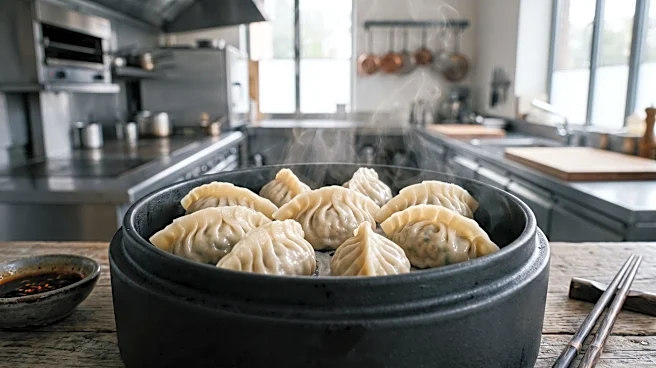
of $27.4 million in sales in 2024, nearly double that of its closest competitor. This success is attributed to its systematic approach to food preparation, particularly in dumpling production. Historically, Chinese-American restaurants depended on cheap family labor for tasks like dumpling folding. However, with improved living conditions in China and a decline in immigrant labor, this model has become unsustainable. Din Tai Fung has implemented a 12-week training program for dumpling folding, with a dedicated dumpling training manager in each U.S. restaurant. This initiative addresses the previous 'bottleneck' of finding skilled labor, turning a traditional craft into a structured corporate job track. The company aims to maintain its high-quality standards, with each dumpling requiring 18 folds and weighing 21 grams, a process that traditionally took extensive practice to master.
Why It's Important?
This shift by Din Tai Fung signifies a broader transformation within the U.S. Chinese restaurant industry, moving away from informal, family-based labor towards formalized corporate structures. This change has significant implications for labor practices, operational scalability, and the economic landscape of ethnic cuisine in America. By professionalizing roles like dumpling folding, Din Tai Fung is creating structured career paths with competitive wages, such as entry-level hourly jobs starting at $20 and manager salaries at $100,000. This contrasts with the historical reliance on low-wage family or immigrant labor, which is becoming increasingly scarce. The success of Din Tai Fung and other chains like Panda Express, which generates over $6 billion annually through systematized operations, demonstrates that corporate training and standardized processes can lead to substantial growth and profitability. This model could influence other ethnic food businesses to adopt similar strategies, potentially leading to higher quality control, better working conditions, and increased market penetration for specialized culinary traditions.
What's Next?
Din Tai Fung plans to continue its expansion in the U.S., with three new restaurants opened this year in California and Arizona, and a second New York City location slated for Downtown Brooklyn in 2027. The company's CEO, Albert Yang, indicates that the current constraint on growth is not labor but rather the company's unwavering quality standards and the challenge of securing large, prime real estate locations. This suggests a continued focus on refining their training programs and operational systems to support rapid expansion while maintaining product consistency. The trend of systematization in the Chinese food service industry is expected to accelerate, with other Chinese chains like HeyTea, Chagee, Luckin Coffee, Wallace, and Haidilao also entering the U.S. market with pre-built systems. This influx of established international chains, coupled with the domestic shift towards corporate models, will likely intensify competition and further drive the professionalization of the U.S. Chinese restaurant sector.
Beyond the Headlines
The evolution of Din Tai Fung's labor model highlights a significant cultural and economic shift in how traditional culinary crafts are preserved and scaled in a modern, globalized economy. The transition from an apprenticeship-based, family-centric learning model to a formalized, corporate training program raises questions about the authenticity and transmission of culinary heritage. While systematization allows for consistency and scalability, it also transforms the nature of the craft itself, potentially reducing the artisanal aspect in favor of standardized efficiency. This development reflects broader societal changes, where economic pressures and changing labor demographics necessitate new approaches to traditional industries. The success of Din Tai Fung in making Chinese food 'aspirational' for younger generations, as noted by Albert Yang, also points to a cultural re-evaluation of ethnic cuisines, moving them from niche markets to mainstream appeal. This could lead to a greater appreciation and demand for high-quality, authentic ethnic foods, but also a potential homogenization of culinary practices as they adapt to corporate models.