






What's Happening?
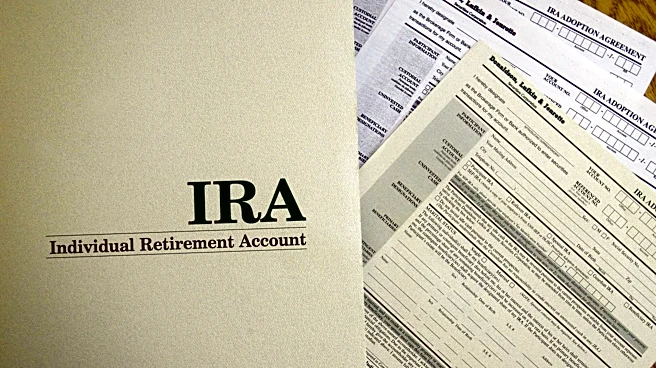
Business owners in the U.S. have various retirement plan options, including 401(k)s, SEP-IRAs, and cash balance plans, each with distinct contribution limits and administrative requirements. The choice of plan often depends on the number of employees
and the owner's proximity to retirement. A 401(k) serves as a base layer, allowing owners to defer a portion of their salary up to IRS limits, with total contributions (including employer money) capped at $72,000 in 2026. Cash balance plans, which are defined benefit plans, can sit atop a 401(k) and profit-sharing, enabling older owners with high incomes to contribute over $200,000 annually. SEP-IRAs are simpler but require the same contribution percentage for all eligible employees, potentially making them more costly for businesses with many staff members compared to a 'full stack' approach combining 401(k), profit sharing, and cash balance plans.
Why It's Important?
The selection of an appropriate retirement plan is a critical financial decision for business owners, directly impacting their personal wealth accumulation and tax liabilities. These plans offer significant tax advantages, allowing contributions to be deductible, grow tax-deferred, and be taxed only upon withdrawal in retirement. The ability to move business profits to a personal balance sheet before taxation is a unique benefit. The complexity arises from balancing the owner's desire to maximize personal contributions with the need to comply with non-discrimination testing and provide benefits for employees. An optimized plan can lead to substantial tax savings and accelerated retirement funding for owners, while a suboptimal choice can result in higher costs or missed opportunities for wealth building.
What's Next?
Business owners should consult with financial advisors, plan administrators, and actuaries to design a retirement plan that aligns with their specific business structure, employee count, and financial goals. Key considerations include the cost of contributions for staff, the flexibility of yearly contributions, and the administrative burden. For solo business owners, a solo 401(k) often allows for the highest contributions. As businesses grow, owners may need to transition to more complex plans like a 401(k) with profit sharing and a cash balance plan. Regular review of the plan is essential to ensure it remains suitable as the business evolves and IRS limits adjust annually. Small employers may also qualify for federal tax credits to offset start-up costs for new plans.
Beyond the Headlines
The strategic design of retirement plans for business owners highlights a nuanced aspect of U.S. tax policy, which aims to incentivize both individual savings and employee benefits. The 'full stack' approach, combining multiple plan types, demonstrates how sophisticated financial planning can leverage various tax codes to achieve significant wealth accumulation. However, this complexity also underscores a potential disparity, where larger businesses or those with access to expert financial advice can optimize their retirement savings more effectively than smaller entities. The requirement for non-discrimination testing ensures that these tax advantages are not solely for the benefit of owners but also extend to the broader workforce, reflecting a societal goal of promoting widespread retirement security.